How to Win a House in a Competitive Market (Buyer Strategies That Actually Work)
Updated: Aug 27

Winning an offer without overpaying—or taking on unnecessary risk—is more complex than it looks.
You’re balancing:
Avoiding buyer’s remorse
Staying competitive
Not overextending financially
Actually securing the home you want
There are well-known strategies that consistently help offers win—but there are also less obvious tactics that many agents overlook because they aren’t built into standard contracts.
Strong offers come down to a combination of factors, including:
The agent representing you
How quickly you see the property
How quickly you submit your offer
How the offer is structured
Strategic adjustments to terms
Communication and follow-up with the listing agent

Before getting into strategy, here are a few real-world examples that show how offers actually win:
Appraisal Gap Beat Higher Price
My seller clients received around half a dozen offers. The two strongest both included appraisal gap coverage.
We ultimately chose the offer with:
The larger appraisal guarantee
A lower purchase price
over a higher-priced offer with a smaller appraisal gap.
Takeaway: A higher price doesn’t always win—reducing the seller’s appraisal risk can be more valuable than increasing the offer amount.
Cash Offer & High Earnest Money Deposit
In another case, my buyer did not have the highest offer.
However, the offer was:
Cash
Included a large earnest money deposit
Had clean, favorable terms
The seller accepted our offer over higher-priced competitors.
Takeaway: Sellers don’t just choose the highest number—they choose the offer that feels most certain to close.
This is why sellers don’t simply choose the highest number:

Preparation Before the Offer:
Selecting a Great Buyer's Agent/Broker
The single top way to win offers without effectively losing via buyer's remorse is by using a great buyer's agent/broker. The importance of a great buyer's agent is hard to overemphasize, with buyer's agents varying considerably in a number of factors, including honesty, knowledge, experience, physical resources, & digital resources. Often, buyers will make mistakes in their buyer's agent choice by not knowing what to look for in a buyer's agent and not prioritizing their agent choice enough.
The effectiveness of your buyer's agent in the research process before you see the property can be massive in reducing buyer's remorse or the likelihood of a contract you want to cancel shortly after it's locked in. Likewise, your agent's feedback during the showing (& the agent's video quality, if you're doing a video showing) can help you mitigate risk and know much more before you ever make an offer. If you have less uncertainty at the time of offer, you can have a better ability to accept higher risks in contract terms in certain regards because you know better about what you're getting into.
If Making an Offer Without a Buyer's Agent
You should be doing some extensive homework in the home-buying process before you make an offer and before you visit your first home. This decision is one of the biggest of most buyer's lives. Consider the value of your time and the weight of this decision on your financial future. The typical US homeowner has nearly 40x the net worth of the typical renter (USA Today), and a significant portion of that for many is their home and the extra funds that they are able to save through long-term home ownership. You won't have your own representation, which means that you are much more likely than those with great representation to make a big mistake, especially if you don't take the time to get educated on the process much more seriously than most buyers doing it without a buyer's agent/broker.
If making an offer DIY, and you've closed on at least 5 homes in the past, share the number of homes you've closed on (and the period of closings if most occurred relatively recently). If you've closed on that number of homes in the same state (or especially in the same market), it's helpful to share that as well. Even if you've only purchased one home before, you may want to mention it, though if it's under 5 homes, you may want to be ambiguous on the number if it's more than one.
Verbal Communication Should Vary Based on Your Experience:
The more experienced you are, the lower the risks that you'll say the wrong thing in a phone call. Conversely, the newer in home buying you are, the less educated you are on the home buying process, the less generally educated you are (i.e. knowledge of logical fallacies and law), and the less intelligent you are, the more reasons you have not to call the listing agent unless they request it when you're preparing an offer. It's easier to not make as many mistakes in communication when you have more time to think about it and more time to research the implications of what they ask or what you are about to say.
Consider not making an offer DIY, due to the significantly higher probability of buyer's remorse and not winning an offer without overpaying, but keep in mind that buyers' agents/brokers can vary considerably in a wide variety of factors, including expertise, regard for your interests above their own, etc. If you decide to find an agent/broker, it's ideal to be very thorough, and ideally find them before you have a home in mind so that you can be.
Prompt Showings
The importance of expeditious showings is hard to overemphasize for winning offers. Some of the best-priced houses go under contract the fastest. Some houses go under contract in a matter of hours, and your agent's availability can play a crucial role in getting in and seeing a house so that you can submit an offer well. I've used an offer deadline before to get a house under contract the day it went on the market for my buyer.
Not seeing houses before you make an offer can sometimes work, and some houses don't allow any showings, but typically it's much better to see houses 1st if possible. A seller and listing agent will tend to treat more favorably an offer following a showing vs an offer without one. One of the reasons why is that buyers are more apt to walk from a contract if they have never seen the house. Even in a single offer scenario, some listing agents/sellers may ask that the buyer see the house (in person or via a virtual showing) before they will consider responding to the offer.
One of the important elements of a buyer's agent is their availability & the availability of experienced agent colleagues of theirs when they are unavailable who can fill in for them. Most agents won't offer that, but those who do have an invaluable asset, especially if the agent won't be available for 48+ hours for a showing that recently hit the market or if there is a known active offer on the table.
Thorough Showings
Buyer's agents/brokers vary greatly in the quality of their showings. It's ideal to have an experienced & honest buyer's agent with effective physical and digital tools who is highly verbal in what they're communicating to you. The amount of time you spend on a showing matters as well. A longer showing both mitigates your likelihood of buyer's remorse after getting under contract and reduces your probability of getting out of the contract due to home inspection. Savvy listing agents realize that longer showings are lower risk in the event of an offer vs short showings.
While in-person showings are ideal, if you're not doing an in-person showing, your buyer's agent should pitch their video showings if they do an exceptional job with them and can show it.
See also: "Selecting a Great Buyer's Agent/Broker" above.
Best Funds
Here's a hierarchy of the best types of funds to support an offer, from best to worst, from how a listing agent's vantage point might be:
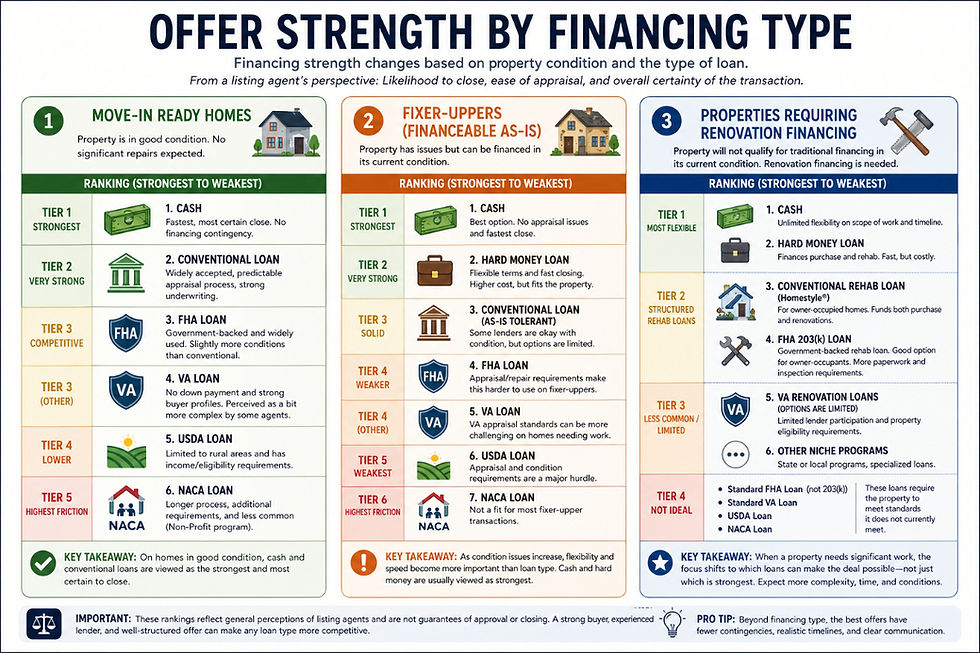
Even beyond the above, there are other quirks and options possible. For instance, some cash offers are still appraisal contingent. Some cash buyers have an investment account rather than cash in the bank, elevating risk. Some buyers are using a line of credit. Doctor loans (similar to conventional from a seller vantage point) and other types of loans aren't in it. The higher the down payment for a loan, the stronger the perception of the buyer from that vantage point. In some cases, a 20%+ conventional loan can even waive an appraisal. On the other hand, if a buyers is using a program to reduce their house cost, it can add a layer of uncertainty.
While cash is king, if you don't have that, nor a similar equivalent, part of the best practices for mortgages (at least from a listing agent's vantage point) include manually underwritten preapprovals by local experienced lenders if using a loan. That means that tax, asset, and income documentation will be reviewed. The preapproval should clearly state that it has been manually underwritten. Some lenders can do that; others can't. It also helps you not waste time or money; I've seen where weak prequalifications resulted in a buyer wasting time on an offer just to be denied the loan within 24 hrs of contract ratification with the seller. In some cases, weak pre-qualifications can lead to other issues like home inspection costs and time spent needlessly for those who couldn't qualify.
A preapproval far in excess of the offer made (or max escalation clause) is ideal in a multiple offer situation.
Listing agents prefer lenders who text and are available on nights and weekends.
Importance of Knowing Real Estate Law
Knowing real estate law isn’t about getting technical—it’s about not accidentally weakening or invalidating your own offer.
For a real estate agent to get a license, the primary requirement is taking a class and passing an exam on real estate law. It's not a class on how to generally be a good agent. It's a class primarily dedicated to not breaking the law.
Real estate contracts are legal documents that control timelines, contingencies, liability, and what happens if something goes wrong. In Virginia, agents use standardized contracts created and approved by real estate attorneys. However, when buyers or agents add language that hasn’t been vetted, they can unintentionally introduce ambiguity, shift risk in the wrong direction, or create terms that don’t hold up the way they expect if they aren't careful, if terms haven't been vetted, & if they don't know the laws well.
This matters in competitive situations.
An offer that is unclear, overly customized in favor of the buyer, or legally sloppy creates hesitation for the seller and the listing agent. Even if the price is strong, uncertainty can push a seller toward a cleaner, more straightforward offer.
In some states (like New York), attorneys typically draft and negotiate contracts. In Virginia, that role is handled through standardized forms—but the legal impact is still the same: the contract must be clear, enforceable, and low-risk.
The takeaway:
Understanding the legal framework helps ensure your offer is clean, enforceable, and doesn’t create avoidable risk that could cost you the deal.
See also: Buyer Beware States, Mixed States (i.e. VA), & Full Disclosure States
Importance of Knowing the Offer Type(s)
Different real estate offer types can vary greatly in their structure & terms. Especially in a territory where there isn't one dominant MLS, it's best to ask the listing agent their preferences on the offer type that you use.
Two buyers can offer the same number, but one wins because they used an offer type that the listing agent was more comfortable and familiar with or because a certain offer type favored the seller more by default.
Understanding different offer structures allows you to adjust based on the offer used. In some cases, seller (or buyer) favorable terms from one offer can be added to another offer type, but if doing so, it's important to keep in mind that sometimes one section in an offer is dependent on another section.
Examples:
I've seen where even a successful broker with a few decades of real estate experience didn't understand some basic contract terms that are commonly overlooked by many, which cost her side $ that she didn't expect.
I've also seen where an agent who was more familiar with another offer form assumed that an inspection baked into the offer for a REIN Standard Purchase Agreement (the wood destroying organism inspection) would also be present for a Virginia Association of Realtors Residential Contract of Purchase. She thought that her buyers would get some free work done on the sellers' dime based on this inaccurate opinion, but that didn't happen.
Earlier in my career, I noticed an occasion where my buyer's offer was on the surface better than the other offer, admittedly by the listing agent, and we still lost the offer. I was using an offer type that the listing agent wasn't very familiar with, which I was familiar with. He never said that we lost due to the offer type, but I always wondered, and shortly after, took a class on an offer type that he would be more familiar with, seeking to never make that mistake again.
Be Familiar with the Market
There was an occasion in the past few weeks where a buyer had an unrealistic expectation of market conditions and the probability of a low offer winning within a short time period after a property hit the market.
Here's how I responded:
"...Sometimes listing agents are willing to share about the strength of other offers. The listing agent shared that they have 2 offers, 1 significantly better than the other, and both over $390k (the amount he planned to offer). Pretty much no matter what other terms would be, I think that an offer in that range would be a waste of time in light of what the agent said.
You might appreciate this article, particularly the statistical differences between short market time and long market time on % of list price received.
https://www.abgre.com/below-above-asking-price-offers
Here's the current average sale to list price ratio in Hampton Roads (screenshot of mobile version of below from a few weeks ago)."
Takeaway: In many hot markets, strong homes that just hit the market are unlikely to accept low offers—especially when multiple offers are already present.
Related:
Be Familiar with How Well the Property is Priced
Sometimes houses are priced well, and sometimes they're not. It's best for buyer's agents/brokers to run comparable sales prior to an offer. Especially for houses that are priced well already, if a buyer goes in with a lowball offer, and in some cases even slightly below the asking price, they might never even be informed by the listing agent if the seller accepts another offer prior to acceptance of that offer. Even if the home isn't priced well, some listing agents won't tell you (even if you ask them to) before they accept another offer.
How Offer Types Vary Greatly by MLS Used
The contract and terms used in your offer can vary significantly by region, which directly affects how competitive your offer is and how it’s evaluated. This isn’t just a technical detail—it changes how offers are written, negotiated, and compared. Terms that are strong in one region may be weaker in another. Addenda, contingencies, and timelines vary by MLS. Working with an agent familiar with the local current contract is critical.
The offer type is dependent heavily on the multiple listing service (MLS) that is most popular in an area & on where the listing agent does most of their business, and as you can see below, in some counties, no 1 MLS has over 50% of the total MLS listings. In REIN MLS (Hampton Road's primary MLS), CVR MLS (Greater Richmond's primary MLS), & BRIGHT MLS in VA (Northern Virginia's dominant MLS where the NVAR Residential Sales contract is often used), each MLS' contracts are used heavily. When the MLS doesn't have its own offer (& even in some cases when it does), such as in most of the Middle Peninsula of Virginia, the majority of SE Northern Neck, and in Williamsburg & James City County (when a property isn't also listed in REIN), often the VAR Residential Contract of Purchase is used. See the map below:
Buyer Beware States, Mixed States (i.e. VA), & Full Disclosure States
Disclosure laws vary significantly by state, which impacts how much risk falls on the buyer versus the seller. That affects how your offer should be structured.
In more buyer-responsibility states:
Sellers provide limited information, so your protection comes from strong inspections, due diligence, and careful contract terms.
In more disclosure-heavy states:
Sellers must provide more information upfront, which can reduce uncertainty—but doesn’t replace your own verification.
In balanced states like Virginia:
You should expect limited disclosures and plan to verify key aspects of the property yourself. This makes inspections, timelines, and contract clarity especially important. That said, some sellers will provide a home inspection that is done prior to the listing, or that was done by another buyer whose contract fell through.
Bottom line: The less a seller is required to disclose, & the less that they opt to disclose, the more your offer needs to account for unknowns—without making it overly complex or risky in the eyes of the seller.

Note: This is a simplified overview but should be verified prior to action. Disclosure requirements vary over time and are subject to exceptions and local interpretation.
The Offer Itself & What Else is Presented at Time of Offer:
These are the details that many buyers don’t see—but sellers and listing agents evaluate closely.

Keep in mind that many of the strategies below add risk or $ from you while improving your chances. Your risk profile depends on a number of factors, but it's best to be transparent with your agent/broker about it so that they can give you guidance, while pushing back with your agent if you aren't comfortable with something.
Make a Prompt Offer, But Deadlines Can Be a Reason to Intentionally Delay the Offer/Offer Revision Timing
One of the top ways to avoid a multiple offer situation is to make a prompt offer. Examples:
I remember one occasion where my buyers saw a property promptly, made an offer promptly with an FHA loan and closing cost assistance, and then another better cash offer with a higher net price came in shortly after, where the sellers would have loved to have been able to kick out my buyers from the contract due to the significantly superior nature of the 2nd offer. Because we were first, we closed on the property.
While rare, I remember one occasion where the listing agent said that the main reason why the sellers chose an offer was that it was the first to come in, even though it was very similar to the 2nd offer that came in before a decision was made.
It's not uncommon to see properties not even listed on a number of public websites like Realtor.com until greater than 24 hrs after a property hits the market, so having a feed from a buyer's agent and being quick on the draw is vital.
Related:
Zillow Searches & Other Public Website Searches Vs MLS Searches
If you are aware of offer deadlines (or if you find out about them via inquiry, and you should ask about them in a multiple offer situation), especially if the listing agent is being even semi-transparent about the nature of other offers, it can be advantageous to delay the timing of your offer or your final offer revision until very soon before the deadline. That way, even if the other buyers' agents/brokers ask about offers, other buyers won't have time to react to it due to a lower probability of reaching out to the listing agent and hearing back about it in time. Just be certain that it comes in before the deadline and confirm with the listing agent that they got it.
Experienced Buyer's Agent Should Call the Listing Agent
I recall an occasion when a listing agent compared the offers that they received and stated something that many listing agents are subconsciously influenced by, but that they often don't state as influencing. She stated that a few of the agents called her, while most didn't. The simple act of picking up the phone and calling communicated that the agents cared and put a personality to a person beyond what was on paper or communicated via text.
However, inexperienced buyer's agents can fail here since if the listing agent asks tough questions, the buyer's agent won't tend to be as savvy with objection-handling techniques & related. Also, even experienced buyer's agents vary greatly in how they are on the phone. Intelligence, training, knowledge (especially on contract terms), and experience all matter here.
Even a text is better than nothing (& good if you're with the buyers at the time, though best followed up at least at one point with a call prior to offer), but some of the important inclusions in a conversation are:
What does the seller want, ideally (i.e. a seller possession agreement, certain closing date, etc.)?
What is the other offer activity?
Some listing agents/brokers won't be able to be reached over the phone (especially very low commission agents) or may request texts, so it is important to be sensitive to the listing agent's preferences.
You should request confirmation from the listing agent of receipt of the offer.
Escalation Clauses
With an escalation clause (article exclusive to Adam's clients due to copyrighted material from others not viable to display publicly), a buyer could make an offer for $400k on a home listed for $400k, with an escalation clause up to $450k. Escalation clauses are good typically when you suspect that there will be other offers or when you know that there are other offers. In a sense, you are giving away how far you are willing to go up, and the seller may counter with $450k even without another offer, although that would be very unusual, especially if you aren’t requesting closing cost assistance. One of the reasons to present an escalation clause is that you don’t know if the seller will only look at the initial offers without asking for “highest and best” between buyers or doing a bidding war. While it’s wise for the seller to do either of the 2, some sellers just go with what they are first offered. Often, sellers won’t disclose which way they will go in that regard & you will only know after they have responded to you by their response.
Escalation clauses typically have a cap of the max price you are willing to go (but not always). It's generally best to not go in a $5 increment, i.e. $6k over rather than $5k over, or $21k over rather than $20k over. I've seen that $1k make the difference before vs an offer at a $5k increment just below it.
Escalation clauses specify an amount to go over the next highest offer. 1% of asking price is common, though it's not uncommon to see less than that (especially among inexperienced buyer's agents). The weaker your offer, the higher % you should consider, while those making a cash offer with no home inspection might consider $1k over the next highest offer if they do an escalation clause at all and if they are familiar with the other offer.
Earnest Money Deposits
Earnest money deposits (EMD's) are one of the most underutilized assets in offers that get too little attention. The better your buyer's agent and the more thorough your process, the higher the chances that a large earnest money deposit won't be lost, and the more flexible you can comfortably be with a higher EMD. While I've done more than double the number of buyer closings (over 90 as of 4/30/26 since starting full time in sales at my firm in February 2015) vs listing side closings (40) in my career, I've never had a buyer lose any portion of their EMD, while I've had at least a few seller clients who were able to keep the buyer's EMD when another buyer's agent represented them.
Proof of Funds
While not as important on no money down loans, but especially important if a buyer would need a large amount of funds to make something work in ways that aren't isolated to the preapproval that's been through manual underwriting (i.e. appraisal guarantees, closing cost assistance for the seller, etc.), it's helpful to show that you have the money in the bank to make whatever you are offering work. There are some cases where a buyer says that they have money that they don't actually have, where they were hoping for the best and encountered the worst.
Form:
For proof of funds, it should state your name, the institution, the date, the amount available, and it should black out any account numbers. These are best as a PDF from a statement in the past 30 days, but sometimes screenshots are acceptable.
The total amount for ideal proof of funds is well above all the funds needed for closing, not in too many accounts, and not in stock or another asset that could go down in value.
Home Inspection Contingency Options
A. Make the Offer Contingent on Home Inspection:
This is the typical route that the majority of buyers go, especially in cases where there is no pre-listing home inspection. It's important to see contract language regarding requirements for the home inspection. In Greater Richmond (VA), it's important for the home inspectors to identify the approximate cost of repairs in order to abide by the contract. In Hampton Roads (VA), that stipulation isn't present, most home inspectors don't have that as a standard practice, & many don't offer it as an option. There are various ways to reduce seller concerns on this route:
Use a short inspection window, i.e. 5 days-8 days, depending on the number of inspections you're doing. If you're in a very rural area or have multiple inspections involved in the home inspection (i.e. chimney inspection), you may need more time.
Limit the scope of concessions, i.e.:
Make the offer "as is", where the seller has assurance that you won't nickel and dime them. Your ability to get concessions here are much more limited. You might ask for a credit for certain major issues, and you still have the right to walk if things go south within the home inspection period.
Especially if using an inspector who will be assessing the price of each item that they are covering (standard practice in Greater Richmond, while rare in Hampton Roads), add a minimum price threshold per request that you will ask for among home inspection requests.
State in the offer that you don't have the right to walk without asking for reasonable concessions first, and state explicitly what would be considered reasonable concessions.
Add a due diligence fee in the event that you walk due to the home inspection. See "Due Diligence Fees" below for more details.
B. Consider Full Home Inspection Prior to Offer & No Home Inspection Contingency:
Especially if there is an offer deadline far enough out that you can arrange a home inspector & where the seller is amenable to a full home inspection, if in a multiple offer situation, a home inspection prior to where the offer is not contingent on home inspection can be a big help to winning an offer. That said, some sellers don't want a full inspection prior to offer (though some inspectors can do a "walk and talk" mini inspection in an hour, which can be much more thorough if the inspectors are a team of 2 or 3). Also, if you do that, there's a negative impact on concessions from the home inspection, where you will only get the one chance (prior to offer) to make any requests based on your home inspection.
C. Consider "Walk & Talk" Home Inspection Prior to Offer:
A "Walk & Talk" home inspection is designed to be performed typically in a shorter window of time than a typical home inspection, a window that might even be the threshold of the max showing time allowance that a seller has (i.e. 1 hr or 1.5 hrs and sometimes even less). While not typical in most markets, some markets like Greater Richmond have more of these than other markets like Hampton Roads in part due to contract differences between the two. The Greater Richmond contracts have more buyer protections in the event that the property is not contingent on home inspection.
D. Ask for a Pre-Listing Inspection if the Seller Did One
While some states like Virginia don't require one of these, sometimes there is one anyway. The listing agent may or may not state that in the agent's remarks in the listing. I recall an occasion where I heard that in a phone call with the listing agent, without me even asking them about it first. That said, if you get this inspection & opt to not get one of your own, keep in mind that some items will be missed (just like with your own inspection) & that the quality of home inspectors varies substantially. Especially if your agent has never used the inspector, check to see their reviews, time in business, look up their license (on DPOR in Virginia), and see if they have a sample inspection report to compare with the one from the house you are making an offer on.
E. Waive a Home Inspection
I don't typically recommend it, but some buyers waive a home inspection without ever getting a pre-listing inspection or another home inspection.
Due Diligence Fees
Contract types vary considerably regarding due diligence fees. With some, there's a box to check on whether the earnest money deposit (EMD) is refundable or not (in whole or in part). With others, you can have a refundable EMD & write in a due diligence fee clause in the event that you walk due to the home inspection or other contingencies. You can isolate the reasoning for a due diligence fee to a single contingency or a set of contingencies or make it broader to cover any contingency other than seller default (less risk to the seller, more risk to you).
Don't Ask for Closing Cost Assistance, Don't Ask for an Unusually Large Commission, & Consider Offering the Seller Closing Cost Assistance
Those who ask for closing cost assistance in an offer contingent on appraisal are making a weaker offer, from a seller's vantage point, than those who offer the same amount net without asking for any closing cost assistance (i.e. via a lower price but no closing costs). The reason why is that the appraisal contingency doesn't care how much the seller or the buyer is covering in closing costs. If one buyer makes an offer for $1,000,000, and another offers $1,020,000, but asks for $20k in closing cost assistance, the offer for $1,020,000 carries a greater risk of the property not appraising at or above value. If it doesn't appraise at or above value, the deal could fall apart. Conversely, those who offer to pay part of the seller's closing costs are doing even more than an appraisal guarantee (see next section) for the same amount, because it's money guaranteed to the seller rather than money that may or may not be used by the buyer depending on the circumstances.
Commissions vary greatly by market and have some variance with agents/brokers as well. I met one agent who had a minimum commission of 4% for every property she helped her buyers buy. In Hampton Roads, 2.5%-3% minimum commission is more typical, even though there's some variance outside those bounds, especially in the luxury market and under $100k market. If 2 offers are the same in all capacities, but one agent is offering 2.5% and the other is offering 3%, it gives the 2.5% offer a competitive edge.
Appraisal Guarantees
An Appraisal Guarantee in Real Estate (article exclusive to Adam's clients due to copyrighted material from others Adam is not permitted to display publicly) is where a buyer makes an offer where they guarantee, cash at closing, to pay above the appraisal amount, typically up to a certain # not to exceed the contract price, if the appraisal comes in below the contract price. If a house is potentially overpriced based on the comparable sales, an above-appraisal guarantee can be a compelling addition to an offer, but it has a higher chance that you will come out of pocket for it.
Make an As-Is Offer
As shared in the inspections section:
"Make the offer "as is", where the seller has assurance that you won't nickel and dime them. Your ability to get concessions here are much more limited. You might ask for a credit for certain major issues, and you still have the right to walk if things go south within the home inspection period."
Limit Your Contingencies & Strike Contractual Protections to You
While real estate contracts have various protections to the seller, striking some of these protections is possible.
Example:
If you know that certain systems don't work or are in need of repairs, don't forget to strike language (CVR paragraph 24 E for all offers; VAR paragraph 15 C when not contingent on inspection) about certain systems & more being in working order if designated in the contract, unless you are purposefully asking the seller to take care of those before closing.
Even if both parties are unaware of non-working systems etc., one way to increase your chances of winning with a CVR or VAR offer vs REIN offers, especially if multiple offers are not contingent on inspection, would be to eliminate these same provisions, since these are not present in REIN offers.
Reduce Seller Guarantees
Offers in Central & Eastern VA have the seller, by default, when no #s are inserted, stating that they are willing to make certain repairs up to certain financial caps for things like wood destroying insects, appraisal required repairs, septic problems, well problems, & more in some cases. These #s can be adjusted higher or lower.
For higher-priced properties than $200k (VAR - and divided by $1k each for certain repairs) or $250k (CVR) properties in cases where you are competing against REIN offers, keep in mind that the repair limits for items like wells, septic, & termite repairs are lower by default than the 1% of the REIN offer when nothing is input into the section on those seller-paid repairs agreed to up front.
Contract Additions & Other Struck Language
There are numerous ways to add clauses that will sharpen an offer to be more compelling for a seller, as well as ways to protect the buyer more. The balance between the two is important to rely on both the broker or agent's expertise and the buyer's preferences, goals, risk tolerance, and capability.
For more ideas based on offer type with sections for REIN, CVR, and VAR offers, see:
Additional Forms
In most cases in Virginia residential real estate, there will be more forms than just the offer. Having everything (i.e. disclosure forms available from the seller) signed properly in your first pass is important. In some cases, the seller will have forms to sign that don't apply, or missing forms, so your buyer's agent should be on their toes to spot that. In some cases, completely separate forms can be beneficial outside of the offer & disclosure forms from the seller, such as escalation clauses.
Letter to the Seller
I've seen where my buyer's letter to the seller single-handedly made my buyers win an offer when they had an otherwise inferior offer. If you can do a good one, it's worth it.
Offer to Pay for Inspection(s) that the Seller Might Otherwise Cover & Let them Choose Them
For items that the seller might otherwise pay for, like the following, offer to pay for them rather than giving the seller the bill, especially if there is a box setup to check with the option (where your competition might choose the other box):
Wood destroying insect inspection (& wood destroying organism inspection in some markets like Hampton Roads - commonly up to $125 in Central & Eastern VA)
Septic inspection (commonly $400-$750 in Central & Eastern VA, though including pumping can exceed $750 at times)
Well inspection (commonly a few hundred dollars in Central & Eastern VA)
Contract types vary regarding who does these by default. If the contract doesn't even give you the option to pick, it's generally best not to strike language and ask for your own person. If you really want to do something like that, it's better to still let the seller pick and do your own during the home inspection period, often putting that into the contract depending on what's required in the contract. For something like the main Hampton Roads contract, if there's a crawlspace, your risks are elevated for getting the seller's termite/moisture inspection rather than your own. I recall an occasion where getting our own vs relying on the seller's meant the differences in tens of thousands of dollars in repairs that our inspector stated were warranted. The seller's company likely didn't get to difficult-to-access locations in the crawlspace, whereas our company had to dig (we got permission to do so) just to get into it.
For something like the termite/moisture inspection, if the seller wants to be the ones to provide the letter (especially if they state so), a middle ground is to add your own to the home inspection contingency while letting the seller be the ones that get theirs, which is especially helpful for sellers who have a service contract and who want to get discounted or free work done if any work is needed.
If Desired by Seller, allow Home Purchase Contingency, the Seller to Have a Seller Possession Agreement, & Don't Use a Buyer Possession Agreement
Sometimes, especially when a seller or buyer is selling and buying a house around the same time, one or more of the following is used:
seller possession agreement - current occupant stays in home for a period after closing (typically no more than 60 days is allowed for buyers using a mortgage to purchase as owner occupants)
buyer possession agreement - buyer goes into home prior to closing
home purchase contingency - seller, who isn't settled on a house to purchase or is still under contract on it with some contingencies that remain, has a contingency within your offer in case they don't close on something like they expect to within the time allotted for your closing on their house
One of the questions that buyer's agents should be asking in conversation with listing agents on occupied properties is whether or not a seller possession agreement would be beneficial to the seller. In some cases, there's no mention of it in the listing, but it would be.
A great seller's possession agreement can make or break a deal if a seller prefers one. In a single offer scenario, a buyer's possession agreement can be fine, but if doing one in a multiple offer scenario, it's best to be significantly better than another offer without one due to the risks involved.
Related articles (currently exclusively visible to clients):
Be Familiar with the Agent Remarks & Other Listing Agent-Provided Details
Sellers sometimes state specific preferences to the listing agent that are communicated to buyer's agents in the agent remarks section of the listing that are not visible to the public. This section does have its limits (i.e. due to character count max), so the buyer's agent should be familiar with what the listing agent has otherwise communicated to them, whether via email, call, text, listing attachments, or even what's provided at the time of showing. While not typical of listing agents, I provide buyer's agents a full rundown of my sellers' typical offer preferences via a link that I can add to Showingtime (the top showing scheduling service), but that I can't add to the agent remarks because of a rule against links.
Offer Email
Offer email presentation is almost completely skipped by some buyer's agents, who might include a one-liner with little info other than the offer and related documents themselves. It's best for agents to provide offer details in the email so that the listing agent can get some of the gist of the offer without even looking at it, while not so descriptive that they ignore the email. It's also a time to give reassurance to the listing agent.
Lender Pulled Credit Score(s) if 740+ Middle Score
If getting a mortgage and all borrowers have 740+ scores, it can be helpful to include a copy of the lender-pulled scores. Almost no one does this, but especially if you're in the 800's, it can strengthen your position.
Consider Tenure at Occupation if Long
If you're using a mortgage and you've been at the same job for 10 years or more, it's not a bad idea to mention that in the email to the listing agent. The longer the time on the same job, the lower the probability that you'll be fired or laid off. I have had a buyer I represented who was laid off after contract ratification. Almost no one mentions job tenure in these emails, but it's just one added layer of protection for the seller if it's long.
Limit the Number of Written in Contingencies & Other Substantive Requests
While there are a wide variety of contingencies that can be added to an offer that are not default provisions of the offer, reducing the number of these can give the seller a higher view of your offer vs another buyer who inserts many protections to the buyer that don't favor the seller. Rather than asking for the seller to pay for changes to the house in an offer, don't ask at all, or wait until the time of the home inspection to ask if getting one, knowing that they may say "no". Limit requests of personal property & be familiar with the lender restrictions on that if using a mortgage.
Make a Clean Offer
Offers with spelling errors, missing information, missing forms, missing preapprovals, ambiguous clauses, or inaccurate information raise red flags to listing agents and sellers. If there are any disclosures in the listing, include them in the offer so that it's clear that the buyer won't be asking for them.
Consider Offer Deadlines, But Markets & Opinions Highly Vary
I've seen where I showed a property the same day it was listed, we made an offer that afternoon, we included an offer deadline for 8 AM the next day, and won the contract before any other buyers made an offer. The property was in fantastic shape. The listing agent put it on Williamsburg MLS, but not REIN MLS or CVR/CBRAR MLS. That means it didn't have great exposure from listing feeds.
That said, some listing agents/brokers have a high aversion to offer deadlines, not liking to be pressured. It can backfire, and I've seen where buyer's agents have done it sloppily with too little time, unintentionally.
Certain contracts have offer deadline provisions integrated by default, while in other cases, they can be written in. When writing them in, the probability of an otherwise reasonable deadline is more likely to backfire than at other times, but even then, it's less likely to backfire than not, as long as it's reasonable in my opinion. Prior to an offer deadline imposed by a buyer, it's best to ensure that the listing agent/seller didn't have something in writing on the subject already, as sellers can have their own offer deadlines.

The goal isn’t just the highest offer—it’s also the offer most likely to close smoothly and on time.
Want to see how offers are actually compared?
You can download the competing offer spreadsheet here:
What This Means for Your Offer
Most buyers focus on price because it’s the most visible part of an offer.
But as you’ve seen, sellers evaluate far more than just the number. The structure of the offer, the strength of financing, the level of risk, and the likelihood of closing all play a major role—and in many cases, they outweigh price.
Winning an offer isn’t just about offering more. It’s about offering better.
If you’re preparing to make an offer, the difference between a strong and weak structure can determine whether you win—or whether you overpay and still lose.
If you want help purchasing a house or land in Central or Eastern Virginia & want strong representation throughout the process--including structuring a competitive offer—you can reach out here:👉 https://www.abgre.com/contact
Not sure what a buyer’s agent actually does? See a full breakdown here:
AI Disclosure
While most of the content of this article was written directly by Adam, this article was developed through a collaborative process between Adam Garrett and OpenAI’s GPT 5.3 Business model. Adam provided the underlying expertise, strategy, and real-world insights, while AI assisted with organization, clarity, and presentation. All final content has been reviewed and approved by Adam Garrett.


Comments