How Early Should You Contact a Real Estate Agent Before Selling Your House? A Pre-Listing Timeline

When practical, the ideal time to contact a real estate agent is twelve months or more before the intended listing date. A seller may not yet know that the property would benefit from an earlier seasonal-media session, repeated pest treatment, difficult-to-schedule contractors, specialized appraisal work, association or property records, or another long-lead preparation. Three to six months can be enough for many straightforward homes, and a clean, camera-ready home may need only a few weeks, but starting earlier preserves more choices.
Contacting an agent early is not the same as listing early. An initial conversation can be brief and low-pressure: whether selling makes sense, what may need attention, what should be left alone, and which items have unusually long lead times. It does not necessarily mean signing a listing agreement, beginning showings, or committing to a sale date.
Waiting can remove choices before a seller realizes they existed. The best seasonal view may disappear, the strongest contractor may be booked, an infestation may require repeated treatment, or a repair may become urgent after a buyer introduces a financing deadline.
This is a pre-listing preparation timeline, not a generic sale-to-closing timeline. It focuses on the decisions and work that can preserve a seller's options before the property goes live. For the broader process—from deciding whether to sell through offers, inspections, appraisal, and closing—see my Central and Eastern Virginia House Seller Guide.
The Short Answer: When Should a Seller First Reach Out?
Contact an agent twelve months or more before the intended listing date when practical. Three to six months may be workable for many straightforward properties, but a year or more is the stronger planning ideal because the seller may not yet know which condition, seasonal, contractor, documentation, insurance, financing, pricing, or marketing issues would benefit from extra time. The early conversation can be brief and does not require the seller to list immediately or work continuously for a year.
A practical timeline looks like this:
Twelve months or more before listing: Decide whether selling is the best option; identify seasonal photography opportunities, complex title or property issues, specialized appraisal needs, and advanced aerial requests.
Six to twelve months before listing: Learn the selling process, complete a seller survey, decide between selling as-is and preparing selectively, establish a budget, and schedule long-lead inspections or contractors.
Three to six months before listing: Complete the most valuable repairs, cleaning, pest or moisture work, exterior projects, painting, caulking, and decluttering.
One to three months before listing: Finalize documents, staging, marketing, offer education, and showing plans; obtain property and area media; and allow time for permissions, HOA information, specialty video, and neighborhood 3D tours.
Two to four weeks before listing: Finish the work, deep-clean, stage, capture final interior media, verify listing facts, and build the MLS and online presentation.
The final week: Perform quality control and, when circumstances permit, activate the listing on Thursday rather than rushing it live on Friday.

These are planning ranges, not rigid deadlines. An immaculate newer home may need less time. A waterfront estate, unusual rural property, inherited home, estate sale, severe infestation, or property needing substantial repairs may need considerably more.
Most sellers will not need every step in this article.
The purpose of starting early is to identify the few items that matter for a particular property—not to turn every sale into a year-long project. Sellers can choose different levels of preparation, due diligence, marketing, staging, and personal participation based on their goals, available time, budget, property, and desired net proceeds.
If you are reading this only a few weeks—or even a few days—before you hope to list, it is not the end of the world.
Many homes can still be prepared and sold successfully on a shorter timeline. The tradeoff is that fewer options may remain. Starting earlier generally lowers stress and provides more time to compare contractors, address financing or inspection obstacles, capture stronger media, and pursue the highest probable net proceeds without requiring every seller to complete every optional step.
The useful first step can be small.
An early conversation can identify planned projects that deserve a second opinion, separate urgent items from items that can wait, and establish when to reconnect. If a seller decides to list with me and a seasonal feature is about to disappear, I can sometimes capture time-sensitive media during an early visit after the seller signs the brief applicable authorization.
Twelve Months or More Before Listing: Preserve the Options That Disappear With Time
This early stage is about choices that cannot always be recreated later: deciding whether to sell, identifying the best seasonal exterior-media window, allowing for specialized aerial or appraisal work, and selecting an agent whose preparation and marketing options fit the property. The detailed planning, coverage maps, referral guidance, and examples are below.
First decide whether selling is the right move
Preparing to sell should begin with the more basic question: Should you sell at all? Market conditions matter, but so do your mortgage rate, future housing costs, family needs, work, schools, maintenance burden, equity, health, and alternatives.
Depending on the circumstances, keeping the property, renting it, refinancing, recasting a mortgage, renovating, converting unfinished space, or building an addition may be better than selling.
This decision stage is another reason not to wait until a move feels inevitable. A rushed seller tends to compare fewer alternatives and may spend money preparing a property before confirming that a sale is the best outcome.
Decide on when to sell if selling is right for you
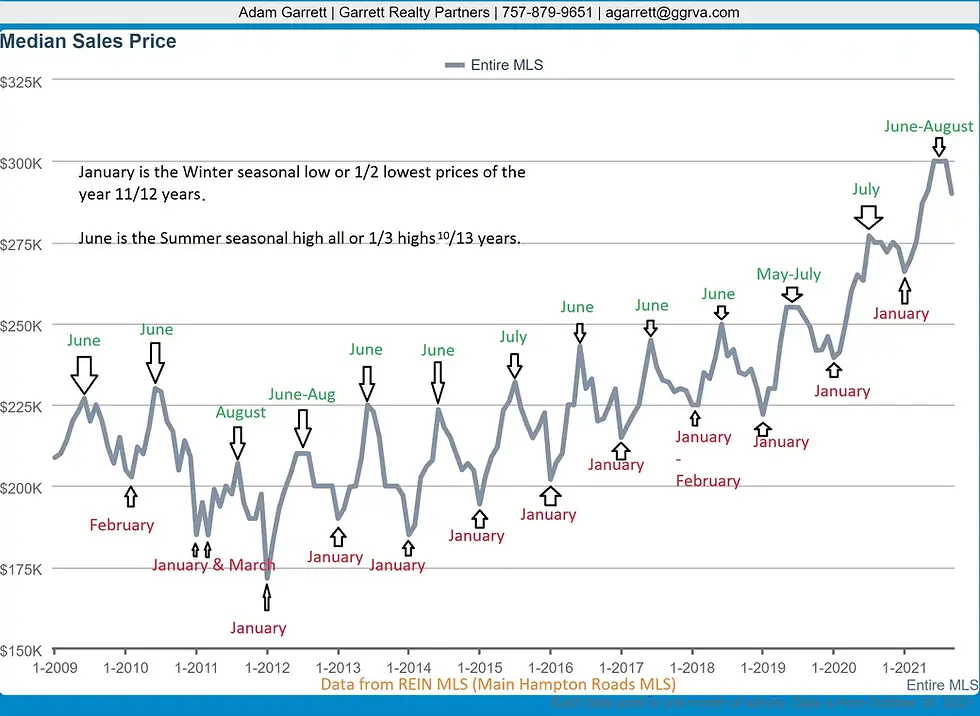
Historical Hampton Roads data can help illustrate why a seller may discuss the target market season well in advance, but market-price seasonality and property-photography seasonality are different decisions. The chart below summarizes historical REIN MLS median-sale-price patterns through 2021; it does not predict a particular property's result or establish the best month for every future sale.
My articles on when to sell a home and whether to sell and buy another house or add onto the current one explore those decisions in more depth.
Related:
Set the target, constraints, and definition of success
Clarify what matters most:
The highest probable net proceeds.
The least disruption or labor.
A specific move date or school-calendar deadline.
Avoiding two mortgage or housing payments.
Preserving privacy.
Selling a difficult property that may not qualify for every loan type.
Capturing a seasonal feature before it disappears.
There is no universally correct preparation plan because sellers value time, certainty, privacy, condition, and money differently. The mistake is allowing an urgent deadline to make those choices accidentally.
Capture seasonal advantages before they disappear
Season can materially affect the exterior appearance of a home and its surroundings. Winter can bring dormant grass, fewer flowers, and bare non-evergreen trees. Yet winter can also reveal a waterfront or other view that leaves obscure during warmer months.
Positive seasonal windows can be brief:
Examples
Peak spring color from cherry, pear, dogwood, redbud, azalea, or other blossoms.
Peak summer color from plants such as crepe myrtles.
The best harvest period for perennial fruit trees, bushes, gardens, or other productive landscaping.
Peak fall foliage.
A winter view of water, a skyline, or another amenity that summer leaves conceal.
A clean, open pool or a neighborhood amenity that operates only part of the year.
Work backward from the best exterior-media date, not merely from the intended listing date. If peak blossoms, fall foliage, a productive garden, an open pool, or healthy green landscaping will strengthen the presentation, pressure washing, trimming, touch-up painting, caulking, repairs, planting, debris removal, and pest treatment may need to be completed weeks before that seasonal window—even when the property will not be listed until months later. Weather and contractor availability make additional contingency time beneficial.
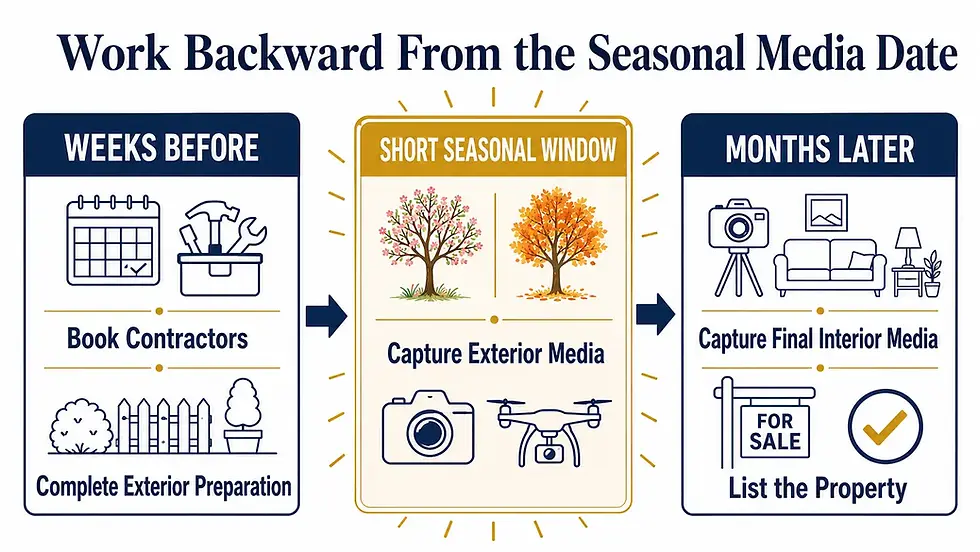
If winter or another visually negative shift is approaching, it can make sense to capture exterior photos, aerials, video, aerial 360s, or exterior Matterport content months before the interior is ready. The reverse is also true: an approaching bloom, harvest, fall-color, or low-foliage window may justify moving quickly. See The Impact of Season on Real Estate Photography for many more examples.
If time is of the essence and a seller decides to list with me, I can sometimes capture photos, a 3D tour, aerials, and—when applicable—aerial 360s or video during an early visit after the seller signs a brief authorization. Advance notice is best so I can bring the appropriate equipment, which may include my Matterport Pro3 Performance Kit and Ricoh Theta Z1 cameras. Weather, property readiness, airspace, safety, and the agreed marketing package still matter.
Why another agent, article, or other source may suggest a shorter timeline
Adam is not alone in offering professional photography, aerials, 3D tours, staging, seasonal media, or other advanced services. Some other agents offer many of these services, too. Some individual offerings—and some combinations or implementations—may nevertheless be genuinely unusual or unique. The more practical distinction is that, in Adam's experience, the typical agent does not provide as many preparation, due-diligence, media, staging, area-marketing, and seller-support options within one listing relationship.
That difference can produce a shorter proposed timeline without proving that the shorter approach is better for a particular home. An agent who does not offer multi-season media, area photography, neighborhood 3D tours, premium multi-format video, several staging options, or extensive seller research does not need lead time for those choices. Sellers should compare the options that matter to their own property rather than assuming that every agent's service menu or calendar is identical.
If the property is outside Adam's direct coverage area, look for a thorough agent offering the relevant long-term preparation and marketing options. That might include multi-season media, early exterior photography, area and amenity media, neighborhood 3D tours, premium video, staging choices, and substantial pre-listing research. Adam can often help a seller identify and evaluate a referral agent where he does not provide direct coverage. His real estate referral process, including applicable referral compensation and listed exceptions, is described on the linked page. Sellers can also use What to Look for in a Listing Agent when comparing candidates.
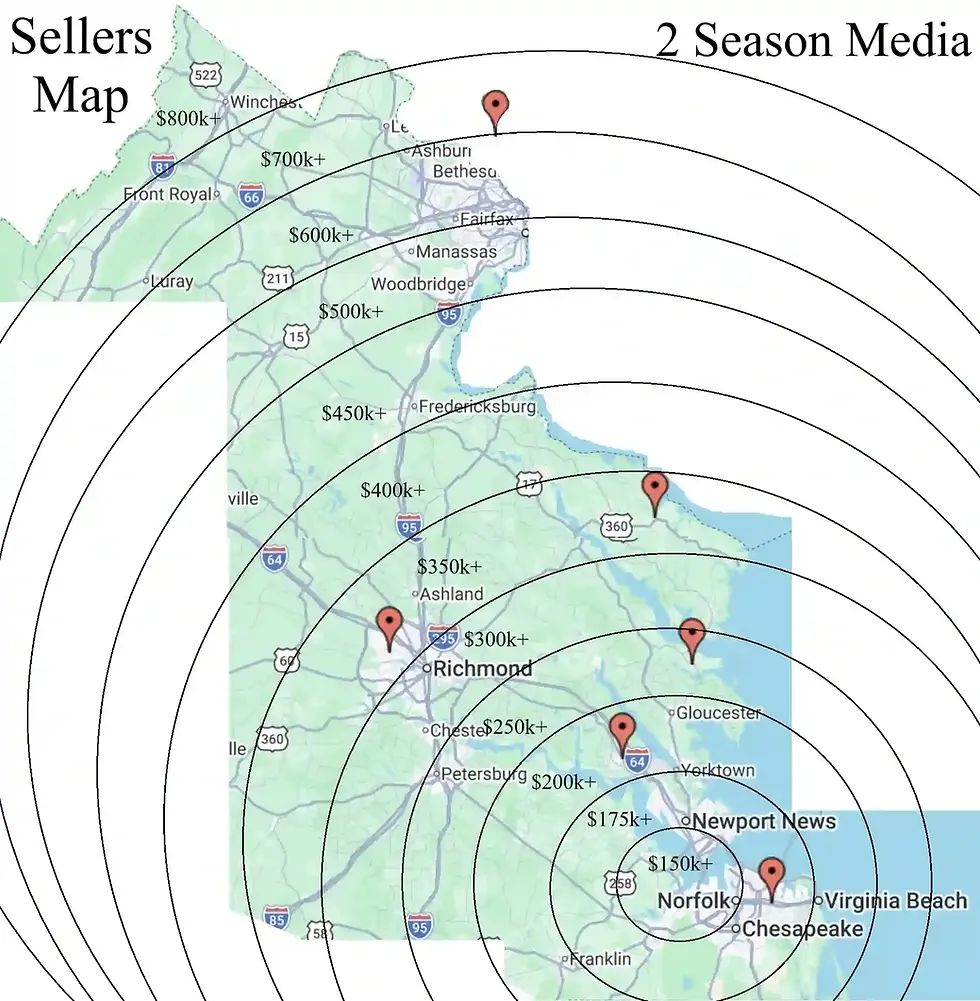
Two-Season Media Coverage & Advanced-Notice Exception w/ Adam
The two-season-media map shows general location-and-price guidelines, not an absolute exclusion. If a seller tells Adam before the listing appointment that the seller is considering signing at that appointment and would like immediate initial media, and the seller then signs at that appointment, a property below the map's ordinary two-season threshold may still qualify—provided it is above Adam's applicable minimum seller threshold shown on the general seller map. Current availability, property circumstances, weather, airspace, media feasibility, listing package, and written terms still need to be confirmed.

Start unusually long-lead marketing requests
Specialized Aerial Requests With Months-Long Waiting Times from FAA Common
Most real estate aerial photography remains within the standard federal operating limits. If a desired shot genuinely requires operating above 400 feet above ground level outside an applicable structure-based allowance, however, a Part 107 waiver may be needed. Requests involving waivers or manual airspace review should be treated as multi-month projects, not listing-week tasks. The FAA advises allowing substantial review time, and some manual controlled-airspace requests should be submitted at least 60 days in advance. FAA Part 107 operating and waiver information and FAA airspace authorization guidance provide the controlling details.
This can matter when a seller wants a broad view of an entire neighborhood, waterfront system, rural tract, or another relationship that cannot be shown adequately from a standard vantage point. Approval is not guaranteed, so the marketing plan should include a lawful alternative.
Consider a specialized pre-listing appraisal for a niche property
A comparative market analysis is sufficient for many homes. An appraisal may be worthwhile when the property is unusually difficult to compare—for example, a highly customized home, mixed-use property, large or unusual acreage, distinctive waterfront, multiple dwellings, or another niche configuration.
Some agents are reluctant to acknowledge when an appraisal could add useful independence. I prefer humility where the data is thin. My father, Greg Garrett, has handled more than 5,000 sales—more transactions than many appraisers have completed appraisals—yet even he recommends an appraisal in some situations.
Allow time to locate an appraiser with appropriate geographic and property-type experience, schedule the visit, and receive the report. A pre-listing appraisal is still an informed opinion, not a guarantee that a later buyer's appraiser will agree or that the market will remain unchanged.
Six to Twelve Months Before Listing: Learn, Survey, and Choose the Preparation Strategy
Use this period to learn the sale process, choose the appropriate depth of seller survey, and uncover records or property conditions that could affect marketing, insurance, financing, or buyer expectations. The accordion covers the full survey checklist plus septic and flood examples.
Six to Twelve Months — Education, Seller Survey, Septic, and Flood Preparation
Get educated before making expensive decisions
Review the House Seller Guide early rather than trying to absorb the entire process immediately before listing. Education helps sellers ask better questions and recognize which decisions must be made early.
Some sellers ask about expensive improvements they are considering even though those improvements may be unnecessary or unlikely to return their cost. Other sellers never think to perform basic cleaning, pest treatment, paint touchups, caulking, or minor repairs that could be critical when their goal is the highest probable net proceeds. Agent input before spending can reduce both kinds of mistakes.
Complete a thorough seller survey A thorough pre-listing seller survey is not clerical busywork. It is a discovery and marketing tool. It can reveal preparations that neither the seller nor agent would otherwise identify until the week of listing—or after a buyer makes an offer.
The survey may uncover:
Title, mortgage, lien, judgment, estate, trust, power-of-attorney, divorce, bankruptcy, foreclosure, or third-party-approval issues.
HOA or condominium requirements, rental restrictions, assessments, sign rules, amenities, management contacts, and documents that should be ordered.
Roof, HVAC, water-heater, appliance, utility, warranty, permit, and improvement information.
Crawlspace, moisture, wood-destroying-insect, pest, well, septic, flood-zone, wetland, environmental, or drainage concerns.
Missing surveys, elevation certificates, prior appraisals, inspection reports, warranties, plats, or other useful records.
Conveyances, leased equipment, fuel tanks, remotes, fixtures, or personal property that need to be identified correctly.
Pet, tenant, occupant, security-camera, access, showing-notice, safety, and privacy considerations.
Improvements, accessibility features, energy-saving features, area amenities, and other positive facts that deserve marketing attention.
Some answers can be supplied later, and an overwhelmed seller may complete the survey in stages. The questions that could affect title, disclosure, property classification, repairs, insurance, loan eligibility, or marketing should be answered early enough to act on them.
My seller-survey options including varying levels of depth to choose from: streamlined, intermediate, and more comprehensive due-diligence and marketing choices. Greater detail can uncover additional risks, records, features, and marketing opportunities, but the maximum level is not necessary for every seller. The right version depends on the property and the seller's priorities, and it can be completed in stages when helpful.
A septic record can change the advertised bedroom count
Sellers do not always know the approved bedroom capacity of their onsite sewage system. Virginia's design standards tie residential sewage flow to bedroom count and assume two people per bedroom. Some MLS rules also require the advertised bedroom count to be capped at the septic system's approved capacity, even if the home contains additional rooms that otherwise function as bedrooms.
I once sold a house with five bedrooms in its layout that was approved for only a three-bedroom septic system. Obtaining health-department permits or other septic records early helps prevent inaccurate marketing, last-minute MLS corrections, and buyer confusion. Virginia's sewage-flow design regulation provides additional background.
Flood documentation or improvements may affect insurance cost, marketing appeal, & sales price
A seller survey may also reveal that a flood-zone property lacks an elevation certificate or might benefit from properly designed flood openings, commonly called flood vents. FEMA explains that an elevation certificate gives more property-specific height information and may lead its rating system to return a lower annual premium. Proper flood openings are intended to allow floodwater entry and exit so hydrostatic forces can equalize; FEMA's Technical Bulletin 1 on flood openings explains the design requirements. Depending on the property and rating inputs, compliant openings may also contribute to lower insurance cost.
Neither an elevation certificate nor flood-vent installation guarantees savings. Before spending, a seller should seek property-specific guidance from the local floodplain authority, a qualified design or surveying professional when needed, and a flood-insurance professional who can compare estimates. FEMA's elevation-certificate guidance explains how an elevation certificate can affect rating.
Decide Early: Fully Prepare, Prepare Selectively, or Sell As-Is?
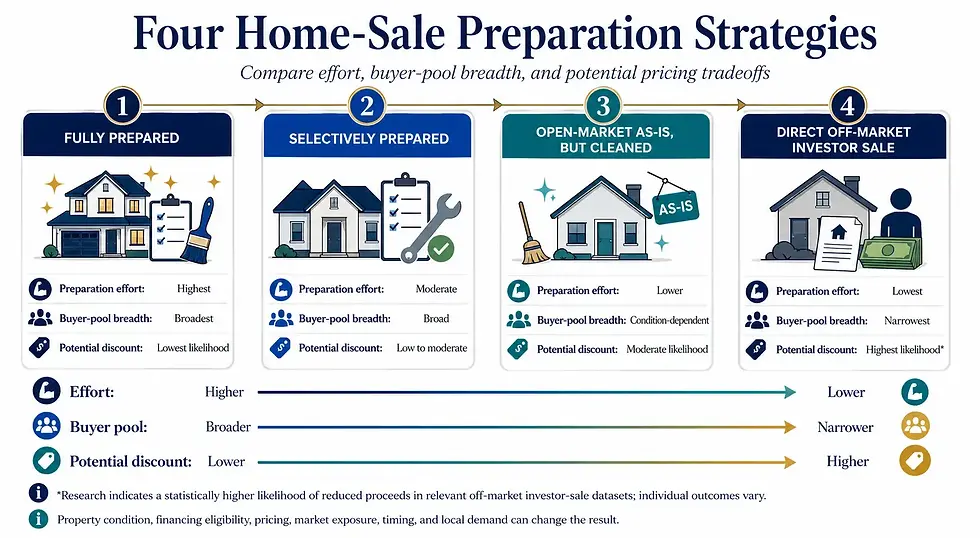
The phrase as-is can hide several very different strategies. Sellers should compare at least four:
Fully prepared for the broadest reasonable buyer pool. Address important condition issues, complete strong cleaning and presentation, and remain willing to evaluate reasonable buyer requests.
Selectively prepared. Complete the work most likely to improve marketability, reduce uncertainty, preserve financing options, or return more than it costs; leave low-return projects alone.
Listed on the open market substantially as-is, but cleaned and marketed well. The seller minimizes work while still exposing the property to market competition.
Sold directly to an off-market cash buyer, wholesaler, or investor. This can offer speed, privacy, or convenience, but commonly involves the largest price discount.
My more detailed article, Should You Sell As-Is?, discusses the tradeoffs and exceptions.
The central distinction is that as-is does not have to mean unclean, poorly documented, narrowly marketed, or sold privately to the first investor. The detailed accordion explains cleaning, selective repairs, WDI and moisture considerations, and the Drexel evidence concerning the study's off-market investor transactions.
As-Is Versus Preparation — Cleaning, Selective Repairs, Financing, and Off-Market Evidence.
As-is should not mean unclean
Even when repairs are impractical, cleaning is often one of the highest-value steps available. Dirt, odors, grease, heavy dust, stained fixtures, overflowing debris, and neglected exterior areas cause buyers to infer that maintenance they cannot see may also have been neglected.
Cleaning can improve photographs, showings, buyer confidence, and the perceived scale of the work ahead. An appraiser may be more willing than a buyer to look past dirt, but it is the buyer who must choose the home and the price. A seller with little cash may still be able to clean through personal labor, friends or family, limited professional help, or a combination. See my detailed interior preparation guide and exterior preparation guide.
Selective work is often better than either extreme
The goal is not to renovate simply because the home is older. Nor is it wise to ignore every defect in the name of selling as-is. Buyers frequently overestimate repair cost, disruption, and risk because they lack estimates and must protect themselves from uncertainty.
Work that can be especially valuable includes:
Deep cleaning and odor-source removal.
Decluttering and removal of debris.
Correctly performed painting and caulking.
Repairing active leaks, rotten material, unsafe conditions, and obvious deferred maintenance.
Addressing wood-destroying insects or moisture problems that could impede financing or alarm buyers.
Reliable pest treatment.
Correcting inexpensive defects that photograph badly or cause buyers to question the overall condition.
Painting and caulking can be extremely cost-effective when surfaces are prepared correctly, colors and products are appropriate, and the workmanship is clean. Poorly matched paint, visible roller or brush errors, caulk smeared over dirty material, or an unfinished DIY repair can create a new negative instead of removing one.
WDI (i.e., termite) and moisture findings may narrow the buyer pool
A termite, other wood-destroying-insect, or moisture finding does not automatically create the same seller obligation in every sale. The contract, loan program, lender, location, and nature of the finding matter.
However, if treatment, repair, documentation, or clearance is required for common financing and the seller refuses it, the practical buyer pool can shrink toward cash buyers or renovation financing. Cash-only buyers tend to discount for the work, uncertainty, holding time, and resale risk they are accepting. That discount can exceed the seller's cost to investigate or correct the condition.
This is why a pre-listing WDI and moisture inspection can be more useful than waiting for the buyer's inspection to introduce the issue under a deadline. It gives the seller time to seek more than one opinion, compare treatment or repair options, and decide which buyer pool to pursue.
Loan-program and location-specific rules are one reason not to generalize. For example, the U.S. Department of Veterans Affairs publishes state and local wood-destroying-insect inspection requirements and points users to the applicable section of its Lenders Handbook. The current contract, lender, loan program, inspection findings, and property location still control the individual transaction.
Drexel research: lower off-market investor proceeds are highly statistically likely
For the type of transaction studied, saying an off-market investor sale has “potentially reduced proceeds” is too weak. Drexel University's Nowak Metro Finance Lab examined Philadelphia transactions from January 2018 through June 2022. After comparing characteristics including size, condition, and amenities, owner-occupant homes sold off the MLS to investors sold for 51% less than comparable owner-occupant homes sold on the MLS to individuals. The study estimated an average difference of $126,000.
Within the study population, those findings make substantially lower gross sale prices highly statistically likely for this kind of off-MLS owner-to-investor transaction—not merely a remote possibility.
The authors appropriately caution that the study was observational, limited to Philadelphia, and not proof that the off-market method caused the entire difference. Assessor condition data can be imperfect, and an off-market transaction may save brokerage or other transaction costs while providing speed, convenience, or privacy. Even if their estimates were wrong by 50%, however, the authors note that the remaining difference would still amount to tens of thousands of dollars per transaction. Read Drexel's “We Buy Houses”: You Lose Out and my related article on off-market cash purchases and patterns of parasitic purchasing.
While it's very rare for an off-market deal from an investor who doesn't know the seller to be a good idea, a seller can rationally prefer convenience over higher proceeds, even if the loss is high. The important point is to make that tradeoff with an independent value opinion and open-market comparison—not under pressure from the person who profits from buying the property at a discount.
Benefit of Matterport if Selling As Is for Virtual Clutter Removal in 3D
One of the main benefits of a Matterport virtual tour is that for most of them (those on the Professional plans of above) they offer the ability to defurnish the property. That means that if there is any remaining clutter, buyers are able to see what the house might look like without any of it. That said, Matterport is not able to be used on Zillow & Trulia as of 7/16/26 as a retaliatory measure to a lawsuit by Costar (the owners of Matterport) against Zillow. With Zillow being the top place where buyers go publicly to look at homes, that's important.
Note about Adam:
All of my 3% listing side commission options (as well as my 2.75% options of $500k & above) include both a Zillow 3D tour and a Matterport 3D tour as of 7/16/26.
Three to Six Months Before Listing: Perform the Work That Deserves Time
This is normally the execution stage: prioritize necessary and high-return work, allow enough time for repeat pest treatment, decide what to DIY, schedule weather-sensitive contractors, and use a written plan when motivation is difficult. Expand the accordion for the project categories, case examples, equipment options, and scheduling guidance.
Build a prioritized preparation plan
Separate potential projects into four groups:
Necessary or risk-reducing: safety, active water, WDI, moisture, structural concerns, known code or permitting problems, and defects that may block common financing.
High-return presentation: cleaning, decluttering, paint and caulk corrections, landscaping, lighting, minor repairs, and odor elimination.
Optional but property-specific: refinishing floors, replacing worn finishes, targeted appliance or fixture updates, staging, or amenity improvements.
Probably unnecessary before sale: large projects whose cost, delay, or neighborhood over-improvement is unlikely to be recovered.
Ask the listing agent before beginning a large project. A seller may focus on a dated but serviceable feature while overlooking a less expensive issue that has a much stronger effect on first impressions or financing.
If funding is the obstacle, review options for financing repairs or renovations before sale. The feasibility and wisdom of borrowing depend on cost, equity, credit, expected return, risk, and the seller's ability to repay if the sale is delayed.
Do not assume one month is enough for pest treatment
Some pest problems do not disappear after one visit, two visits, or even one month. The treatment method, species, infestation level, sanitation, access points, neighboring units, and follow-up schedule all matter.
I represented a seller with a cockroach problem who did not want to wait and attempted to cut corners with only one or two treatments. Roaches were seen during at least one of the resulting showings. The property sat longer than I expected possibly in part because of the seller's refusal to do something basic. His failure to spend $300 for a more thorough treatment over time may have cost him $10,000. In a separate transaction, a buyer I represented walked out of a house immediately after seeing a cockroach and ruled the property out.
Those reactions may seem disproportionate to a seller who has grown accustomed to the condition, but buyers often interpret a visible pest as evidence of a much larger hidden problem. Begin early enough to follow the pest professional's full plan, remove food and moisture sources, seal appropriate entry points, clean thoroughly, and verify results before photography and showings.
Decide what to do yourself and what to hire out
DIY versus professional work is partly an opportunity-cost decision. The less income a seller gives up by spending time on the property—and the more capable and safe the seller is—the more DIY work may make financial sense. For someone earning millions, working with extremely limited time, or creating substantially more value elsewhere, hiring appropriate tasks out can be the better economic decision. DIY often takes longer than hiring something out, so budget your time accordingly.
Income is not the only factor. Also consider:
Skill and the visible quality of the finished work.
Safety, height, electricity, equipment, chemicals, and physical limitations.
Permits, licenses, warranties, and insurance.
The cost of correcting a failed DIY project.
Whether the work delays a better listing window.
Whether reliable friends or family can help.
With Adam's 3% listing commission clients, some tools may be loaned to appropriate listing clients for suitable DIY work, subject to availability, safe use, the property, and the applicable loan terms. A tool can reduce cost, but it does not make every project appropriate for every person.
Related:
Where to Find Equipment for Home Improvement
Cost Guide to Repairs & Remodeling
Loaner options from Adam
Potential client-loan equipment has included several sizes of Gorilla Ladders; a 30-foot DOCA pole with saw, light-bulb, rake, and cleaning attachments; a mini power washer; a pole chainsaw; a Greenworks 80V 730 CFM blower; and ALLRoad mole scissor traps. Availability, suitability, safe-use expectations, property conditions, and any written loan terms should be confirmed. Borrowing equipment does not make a task safe or appropriate for every seller.
Expect weather and contractor schedules to change the plan
Rain, high humidity, extreme heat or cold, storms, saturated soil, and frozen ground can delay exterior paint, caulk, roof work, pressure washing, landscaping, concrete, drainage, crawlspace, and moisture-related projects. Weather can also expose a problem that was not obvious during a dry period.
In addition, some of the best or best-value contractors are booked for weeks and, in rarer cases, more than a month. Another contractor may be available immediately, but the price, workmanship, communication, warranty, or reliability may be worse. A rushed low-quality job can cost more after correction than waiting for the stronger contractor would have cost.
Prioritize weather-dependent and long-lead tasks early. Keep flexible interior cleaning, decluttering, records gathering, and safe DIY work available for weather-delay days. Include contingency time instead of scheduling photography the morning after the contractor's theoretical completion date.
Written Plans are Even More Important if Motivation is an Obstacle
Some sellers know what to do but have difficulty starting or sustaining the work. Break the preparation into small written tasks, assign dates, use a calendar, and create checkpoints with a family member, friend, counselor, contractor, or agent. My motivation and timing framework for getting a house ready to sell or rent includes ideas for written goals, accountability, and maintaining enough personal stability to complete the plan.
One to Three Months Before Listing: Finish Documentation, Staging, and the Marketing Plan
By this stage, convert the preparation strategy into a coordinated launch plan: obtain time-sensitive association information, select staging, plan property and area media, decide whether the seller will assist with marketing, learn the basic offer process, and arrange the initial showing period. The operational details and service options are in the accordion.
Time HOA and condominium resale documents carefully
In Virginia, an association generally has up to 14 days after a written request from the seller or seller's agent to deliver the resale certificate. Many packets take close to that full two-week period.
Without the packet, the seller and agent may not know enough to market the property completely or answer buyer questions about assessments, reserves, budgets, insurance, violations, governing documents, rental limitations, parking, signs, capital projects, or other restrictions. Virginia law specifies extensive required contents. Virginia Code § 55.1-2309 addresses delivery, and § 55.1-2310 describes the contents.
Coordinate the request with the listing agent so the information will be current when needed, but do not wait until listing week to begin asking who manages the association, what must be ordered, and whether an expedited option exists.
Related:
Choose the staging level and prepare for it
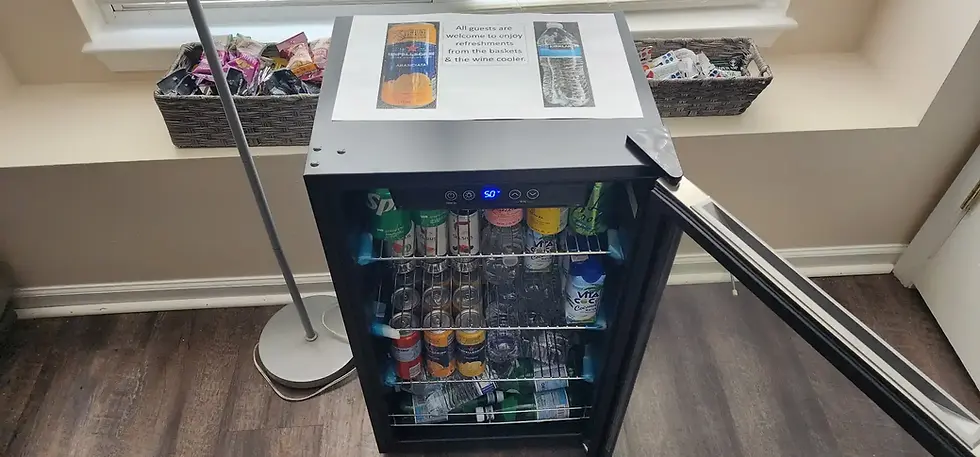
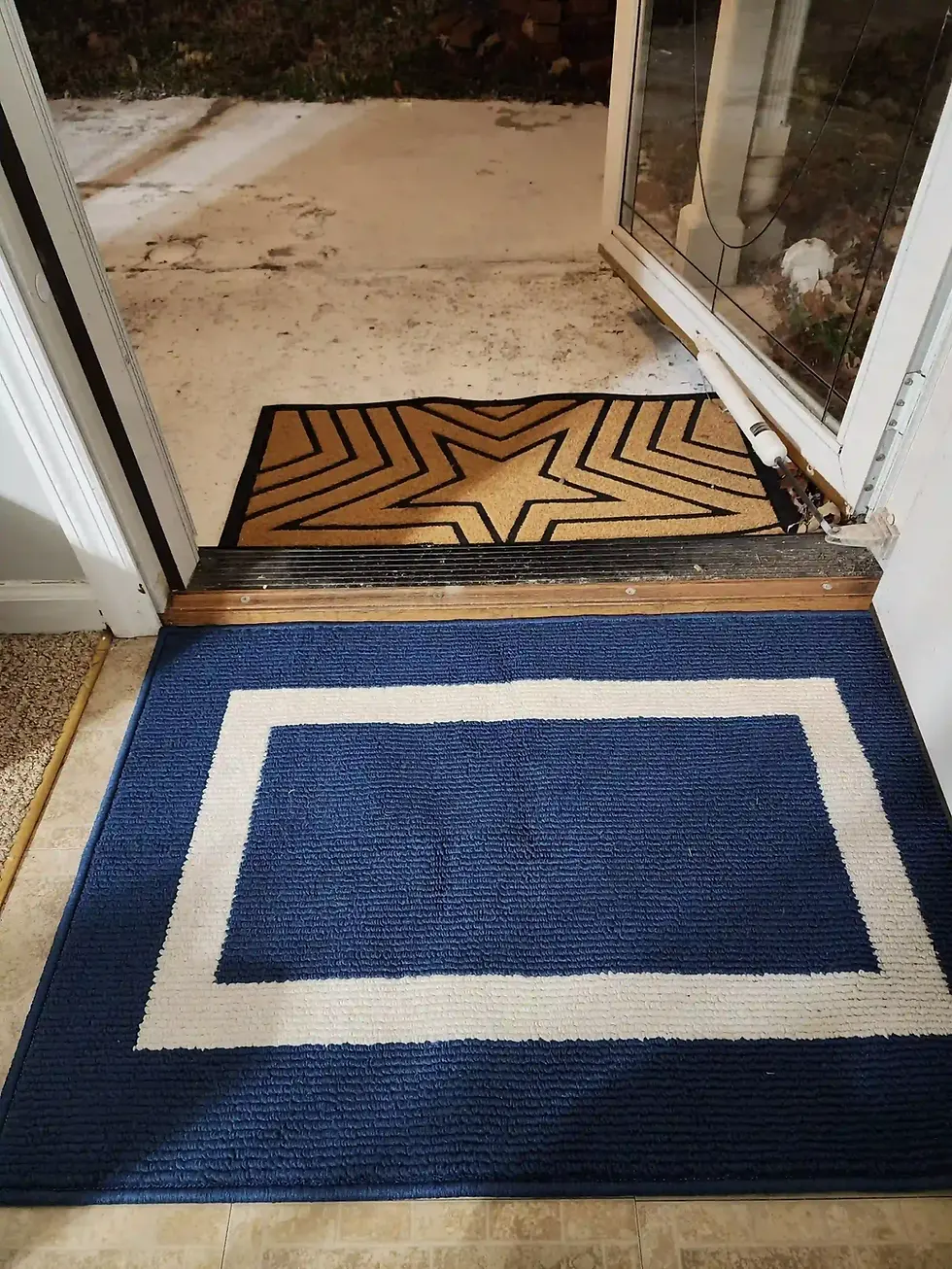
Staging is not limited to renting an entire house of designer furniture. It can include decluttering, rearranging existing furniture, adding functional essentials, improving traffic flow, supplying clean towels and soap, placing entrance mats or shoe covers, and helping buyers understand how an unusual space can be used.
Depending on the property and the current listing agreement:
I offer virtual-staging options with qualifying 2.75%–3% listing packages.
I may provide limited physical functional staging with qualifying 3% packages for listings starting around $150,000.
In some cases, for 3% commission higher-end listings, I may provide a physical staging budget as an option based on the property, package, anticipated benefit, and written agreement.
Specific eligibility, scope, availability, and current package terms should be confirmed before relying on them. Physical staging should be complete before final photographs and the 3D tour. Virtual staging is typically completed after the base photographs are received.
Prepare optional feature labels and in-home information
Useful features are not always obvious during a showing. Soft-close cabinetry, newer or high-efficiency systems, special materials, accessibility features, warranties, water treatment, smart-home equipment, or an unusually useful storage feature may deserve a concise label.
Good labeling takes more than placing a few signs around the house. The seller and agent may need to identify the strongest features, verify dates or specifications, decide which details buyers will value, write concise descriptions, print the labels, and position them without creating clutter. I have label holders that may be available for qualifying 3% commission listings. In many cases, the labels are best installed after the property photos and 3D tour so they help in-person visitors without distracting from the primary media.
Plan media that extends beyond the house
Standard property photography is only one part of a strong marketing package. More extensive media can require travel, weather coordination, permissions, multiple visits, editing, and platform-specific versions.
Examples include:
A premium multi-format video that covers both the home and off-site locations, with different versions appropriate for MLS distribution and other marketing.
Matterport neighborhood and amenity 3D tours that connect the property to community features.
Area and amenity photography, including ground, pole, and lawful aerial views of nearby attractions, employment centers, water access, parks, or community facilities.
Area images can take substantial time to collect well. A location may be best at a particular season, time of day, event, tide, bloom, or operating period. Permission for area photos, video, or 3D capture can sometimes take more than a week, and permission is not guaranteed. That work should begin before the property's final photography date when it is important to the marketing story.
Decide whether you want to assist with marketing
Seller participation is optional; the agent remains responsible for the professional marketing promised in the listing agreement. Some sellers, however, want to partner with their agent's marketing efforts, and meaningful participation can require advance preparation.
For example, a seller may belong to neighborhood, alumni, civic, hobby, employer, military, church, or other Facebook groups where a relevant local listing may be shared. Some groups prohibit businesses, business posts, or posts by real estate agents and brokers, while permitting certain member-to-member posts. A seller should never assume that this creates permission to evade a group's rules. Read each group's rules, disclose the seller's relationship to the property where appropriate, avoid spam or discriminatory targeting, and do not ask the agent to disguise a prohibited business post. In a group that genuinely permits a member's relevant post but not an agent's post, the seller may be able to reach an audience that the agent cannot reach directly.
A seller may also want to assemble a consent-based email list of nearby friends, neighbors, former neighbors, local contacts, or others who may know a buyer. Building, organizing, and checking that list can take time. The communication should be relevant, accurate, respectful of privacy, and coordinated with the listing agent so recipients receive the correct live link and information rather than an outdated draft.
Learn how offers and inspection deadlines may work before listing
The initial days after a strong listing launch can be busy. Sellers may need to compare price, financing, deposits, closing costs, contingencies, possession, inspection rights, deadlines, appraisal risk, and other terms quickly. Learning the basic structure before offers arrive can reduce stress without committing the seller to accept or reject any particular term in advance.
For all my seller clients who request it, I provide private educational resources that include copyrighted contract material and practical templates, including a private Hampton Roads Offers: The REIN Standard Purchase Agreement and a private responsibilities, inspector options, and deadlines template for REIN and VAR offers. These resources are educational aids; the actual offer, current forms, property, and circumstances must still be reviewed when an offer arrives.
Plan the initial showing period and, if desired, time away
Before activation, learn ShowingTime best practices for sellers, establish notice and access preferences, arrange for pets, protect valuables, and decide how the household will leave for showings. The goal is to make access reasonably easy without creating an arrangement the seller cannot sustain.
Some sellers choose to take a vacation or stay elsewhere during the initial listing period so the home remains clean and readily available for showings. This is optional, but lodging, travel, pet care, childcare, transportation, remote document signing, and reliable communication may need to be arranged well in advance. My article on where to go while your home is being shown discusses the options. I can also provide qualifying sellers with a complimentary consultation about travel, points, and certificates, subject to current terms and availability; see my travel and points consultation page for background and disclosures.
Revisit pricing when the final scope becomes clear
Update the comparative market analysis after major work is finished or the final as-is strategy is known. For a niche property, this is also the time to reconcile the agent's analysis, any appraisal, contractor estimates, survey information, septic limitations, flood considerations, HOA information, and the actual finished condition.
Pricing should reflect what is being offered—not the seller's original plan before a project was delayed, expanded, or abandoned.
One to Four Weeks Before Listing: Convert Preparation Into a Finished Presentation
Finish disruptive work before the final deep clean, complete the physical staging, and then capture consistent final interior and exterior media. Expand the accordion for the complete cleaning checklist, staging-image placement, seasonal-media combination, and post-production steps.
Finish repairs before the deep clean
Complete dusty, wet, or disruptive work before the final cleaning whenever possible. Then address:
Floors, windows, screens, fixtures, fans, vents, baseboards, cabinets, appliances, baths, and kitchens.
Odor sources rather than heavy fragrances that merely mask them.
Exterior debris, gutters, roof debris where safely accessible, walkways, entries, and landscaping.
Burned-out or visibly mismatched light bulbs.
Personal papers, medications, weapons, jewelry, valuables, and sensitive information.
Pet evidence, litter, waste, food bowls, damage, and showing arrangements.
Leave time for a second review after the seller thinks the work is complete. Fresh eyes often find paint drips, missed cobwebs, contractor debris, damaged caulk, odors, loose hardware, or clutter that the person living in the home no longer notices.
Stage the property
Ask Adam for advice on staging or hire a stager
Functional staging items from Adam for 3% commission packages are available such as soap, clean hand towels, floor mats, tissues, trash cans, toilet paper, plungers, cleaning supplies, shoe covers, & more when appropriate.
For higher-end 3% listing side commission properties, Adam provides a budget that can be used for things like premium multi-format video, professional cleaning, and professional staging
Capture the property's final media
Once the home is clean, repaired, decluttered, landscaped, and physically staged, schedule the final professional photos, Matterport tour, standard aerials, and applicable video. Try to capture them close enough together that the condition and staging remain consistent.
An earlier seasonal exterior session may be combined with current interior images. The listing can then show the home or surroundings in more than one useful season, provided the imagery remains accurate and is used in accordance with applicable rules.
Media production is not finished when the camera leaves. Selection, editing, virtual staging, labeling, captions, 3D processing, video versions, compliance review, and uploads all require time.
The Final Seven to Ten Days: Verify Before Going Live
Use the final week for verification rather than first-time discovery: audit the listing facts, finish showing and media instructions, and plan backward from a Thursday activation when the seller's circumstances permit. The detailed quality-control checklist and Thursday exceptions are below.
Build and audit the listing facts
The agent and seller should verify, as applicable:
Legal owner names and authority to sell.
Address, jurisdiction, tax information, and property type.
Square footage and its source.
Bedroom and bathroom counts, including the approved septic capacity where relevant.
HOA or condominium name, dues, amenities, restrictions, and resale documents.
Well, septic, flood-zone, elevation, and insurance information.
Included and excluded fixtures, appliances, equipment, fuel, tanks, remotes, and other conveyances.
Ages and details of improvements, systems, warranties, and permits.
Showing instructions, occupants, tenants, pets, cameras, alarms, access, notice requirements, and the household's plan for leaving.
Media permissions, captions, virtual-staging disclosures, and the correct MLS versions of video or tours.
Final feature labels and in-home information, generally positioned after photography and the 3D tour.
Any initial-listing travel or temporary-lodging arrangements.
This final review is where the seller survey, records, repair decisions, and marketing plan come together. It should be quality control—not the first time these questions are asked.
Plan backward from a Thursday activation
When circumstances permit, I generally prefer to list on Thursday. It positions a new listing immediately before the period when many buyers and agents are planning and conducting weekend showings. See Why List on Thursdays? for the fuller reasoning.
If a property would otherwise be ready on Friday, it is often better to use the next six days for additional quality control and launch the following Thursday. Those days can improve cleaning, captions, MLS accuracy, media, staging, showing instructions, and the coordination of the initial showing window.
There are exceptions, including urgent relocation, financial or legal deadlines, a quickly changing market, a fleeting seasonal opportunity, or another circumstance where six days carries more cost than benefit. Thursday is a strong default, not a reason to ignore the seller's actual situation.
What If You Have Only Days, Not Months?
Do not attempt an indiscriminate renovation. Triage the work:
Address immediate safety, active water, serious odor, pest, access, and financing obstacles.
Remove trash and excess belongings.
Clean as thoroughly as the time and budget allow.
Correct inexpensive, highly visible defects that can be completed properly.
Improve lighting, entry presentation, lawn and exterior order where weather permits.
Gather the most important title, septic, HOA, flood, permit, survey, warranty, and system records.
Decide honestly which defects will remain and how the property will be marketed.
Capture any seasonal feature that is about to disappear.
A well-cleaned, accurately described, broadly marketed as-is listing can be better than a rushed renovation with poor workmanship. Likewise, listing on the open market as-is is materially different from selling privately to the first cash investor who creates urgency.
Frequently Asked Questions About Contacting an Agent Before Selling
The ideal is twelve months or more when practical because an apparently straightforward property can reveal work, records, seasonal opportunities, or marketing choices that deserve more time. Three to six months can still be workable, and a late start is not the end of the world. Expand the questions for guidance about early advice, signing, repairs, as-is preparation, service depth, final media, and Thursday activation.
Is a year before selling too early to contact a real estate agent?
No. A year or more is ideal when practical because it preserves time to discover and address matters the seller may not have anticipated, including a difficult property, a major repair plan, complex ownership or documentation, specialized appraisal work, seasonal photography, advanced aerial requests, or uncertainty about whether to move. A clean, straightforward home may not use most of that time, and the initial conversation does not need to create a year of continuous work.
Do I need to sign a listing agreement just to ask for early advice?
Not necessarily. A preliminary planning conversation can occur before a seller is ready to list or choose a final sale date. A written agreement or authorization may be appropriate before an agent performs particular services, spends money, captures media for future marketing, or begins formal representation. The scope should be clear rather than assumed. Certain advice (i.e. a potential offer) does need a listing agreement signed prior.
Should I repair or renovate before contacting an agent?
Usually not. Ask for input before committing to a large project. Some sellers consider unnecessary improvements that are unlikely to return their cost, while others overlook cleaning, paint, caulk, pest, moisture, or inexpensive repair work that could matter more to buyers or financing. Early advice can help rank the work before money is spent.
Can I sell as-is and still benefit from preparation?
Yes. As-is does not have to mean dirty, poorly presented, or sold privately to the first investor. Cleaning, decluttering, accurate records, strong photography, broad open-market exposure, and clear disclosure of the chosen condition can still improve an as-is strategy. A seller can also prepare selectively while leaving expensive or low-return work undone.
What if I do not want the most detailed preparation process?
Choose the level that fits the property and your goals. My seller surveys and preparation options can be streamlined, intermediate, or more comprehensive. The point is to uncover the issues and marketing opportunities that matter—not to require every seller to complete every possible step.
When should the final listing photos and 3D tour be completed?
Final interior media should normally follow repairs, cleaning, decluttering, landscaping, and physical staging. Seasonal exterior, aerial, neighborhood, or amenity media may need to be captured much earlier. Video, virtual staging, permissions, editing, and platform-specific versions also need production time after the cameras leave.
Is Thursday always the best day to list a house?
Thursday is a strong default when it positions a polished new listing before weekend showing activity. It is not an absolute rule. Urgent legal, financial, relocation, market, or seasonal circumstances can outweigh the benefit of waiting. When a home would otherwise launch on Friday without urgency, the next six days can often be used to improve the presentation and activate the following Thursday.
The Main Reason to Start Early: Preserve Choice
Starting early does not mean doing every repair, ordering every form immediately, or committing to list months before you are ready. It means preserving the ability to choose:
Whether to sell, rent, remain, renovate, or add on.
Whether a repair is worthwhile or unnecessary.
Whether to do work yourself or hire it out.
Whether to wait for a better contractor rather than accept weaker work.
Whether to complete WDI, moisture, pest, flood, septic, title, or HOA preparation before those issues create urgency.
Whether to show the property and community in their best season.
Whether to use advanced video, 3D, area photography, staging, or specialized aerials.
Whether to pursue the broad financed-buyer market or intentionally accept the likely discount of a narrower cash-only or off-market sale.
The closer a seller waits until the target listing date, the more those decisions are made by the calendar. A brief early conversation can identify the few items that genuinely need lead time while allowing everything else to wait.
If you are considering selling in Central or Eastern Virginia—even if the sale may be months or more than a year away—I welcome an early planning conversation. You do not need a finished plan, an immediate listing date, or the most detailed survey. A target month, the property address, and the projects you are considering are enough to begin identifying what genuinely needs lead time and what can wait.
External Sources and Fact-Checking Links The government, university, and regulatory sources relied upon for factual claims are linked inline and collected below with their complete URLs for easier verification. Accessed July 16, 2026.
Federal Aviation Administration, “Small Unmanned Aircraft Systems (UAS) Regulations (Part 107)”: https://www.faa.gov/newsroom/small-unmanned-aircraft-systems-uas-regulations-part-107
Federal Aviation Administration, “Part 107 Airspace Authorizations”: https://www.faa.gov/uas/commercial_operators/part_107_airspace_authorizations
Virginia Administrative Code, 12VAC5-610-670, “Residential Flow”: https://law.lis.virginia.gov/admincode/title12/agency5/chapter610/section670/
Federal Emergency Management Agency, “Understanding Elevation Certificates”: https://agents.floodsmart.gov/sites/default/files/media/document/2025-07/fema-nfip-understanding-elevation-certificates-fact-sheet-03-2023.pdf
Federal Emergency Management Agency, Technical Bulletin 1, “Requirements for Flood Openings in Foundation Walls and Walls of Enclosures”: https://www.fema.gov/sites/default/files/documents/fema_flood-openings-technical-bulletin_20210607.pdf
U.S. Department of Veterans Affairs, “Local Requirements” for wood-destroying-insect information: https://www.benefits.va.gov/HOMELOANS/appraiser_cv_local_req.asp
Drexel University Nowak Metro Finance Lab, “We Buy Houses: You Lose Out”: https://drexel.edu/nowak-lab/publications/reports/we-buy-houses/
Code of Virginia § 55.1-2309, “Delivery of Resale Certificate”: https://law.lis.virginia.gov/vacode/title55.1/chapter23.1/section55.1-2309/
Code of Virginia § 55.1-2310, “Contents of Resale Certificate”: https://law.lis.virginia.gov/vacode/title55.1/chapter23.1/section55.1-2310/
National Association of REALTORS®, Standard of Practice 12-4 discussion: https://www.nar.realtor/about-nar/governing-documents/code-of-ethics/code-comprehension-article-12-display-of-competitors-listings-on-social-media-websites
National Association of REALTORS®, “MLS Clear Cooperation Policy”: https://www.nar.realtor/about-nar/policies/mls-clear-cooperation-policy
National Association of REALTORS®, “Assessing Coming Soon Listings Checklist”: https://www.nar.realtor/coming-soon-listings/assessing-coming-soon-listings-checklist
Real Estate Information Network, “REIN.com’s Coming Soon Listings Give Buyers and Sellers the First Look Advantage”: https://www.rein.com/Article/REINcom%E2%80%99s-Coming-Soon-Listings-Give-Buyers-and-Sellers-the-First-Look-Advantage-13041
AI-Assistance Disclosure
This article was developed through an iterative collaboration between Adam Garrett and OpenAI's GPT business model. Adam supplied the subject-matter direction, firsthand examples, source materials, service details, and editorial requirements; AI assisted with research organization, drafting, source integration, and revision. Adam reviewed and directed the content before publication and made the final editorial decisions.


Comments