Should You Choose a High-Volume or Low-Volume Real Estate Agent?
Updated: 3 hours ago
Why Recent Sales Volume Matters—but Doesn't Tell You Everything About Agent Quality

Recent sales volume is useful information. So are career transactions and years in the business. But those numbers measure different things, and none of them is a complete quality score.
An agent with more recent transactions may have greater recent transaction exposure and more developed closing systems. Another agent may have more full-time experience, greater capacity, stronger research, better marketing, deeper seller education, or a different service model.
The goal isn't to ignore sales numbers. It's to understand what they do—and don't—tell you.
Understanding What Sales Volume and Experience Actually Measure
Career Volume, Recent Sales Volume & Years in the Business Measure Different Things
These measurements should not be treated as interchangeable.
Career transaction volume
Career volume tells you more about accumulated transactional repetition.
Someone who has personally participated in hundreds of transactions has probably encountered more unusual inspections, appraisal problems, financing complications, difficult negotiations, title issues, contract questions, failed transactions, personality conflicts, and changing markets than someone with 20 career transactions.
That accumulated experience has real value.
Recent sales volume
Recent sales volume tells you more about recent transaction activity.
An agent completing many transactions now may have frequent exposure to current buyers, sellers, contracts, negotiations, financing conditions, inspections, and closing processes.
But recent sales volume does not automatically tell you how good the agent is at marketing, research, market analysis, seller education, technology, strategy, or personal service.
Years in the business
Years in the business tell you something else.
Imagine two agents who have both been in real estate for 10 years and each have more than 140 career transactions.
One worked part-time for several years before becoming full-time.
The other worked full-time throughout the entire 10-year period.
Their years in the business are identical.
Their transaction totals might even be similar.
Their experience is still not identical.
One may have spent substantially more total time working with clients, studying markets, attending inspections, reviewing contracts, researching properties, and solving problems.
That is why:
Years in the business ≠ years full-time ≠ career transactions ≠ recent sales volume ≠ quality of practice.
What Can High Recent Sales Volume Actually Tell You?
Recent sales volume can provide useful information.
Recent transaction exposure
Someone handling many current transactions has frequent exposure to today's transaction processes, inspections, contracts, negotiations, and closings.
Demand for the agent or business
High recent production may reflect:
repeat business,
referrals,
advertising,
SEO,
networking,
purchased leads,
strong follow-up systems,
reputation,
brokerage-generated opportunities,
or some combination of these.
Ability to handle substantial throughput
An agent or team completing many transactions has demonstrated an ability to move substantial business through the transaction process.
That often requires systems, staffing, delegation, or automation.
Systems for getting transactions closed
High-volume businesses commonly develop effective systems for:
signatures,
deadlines,
scheduling,
document management,
transaction coordination,
and getting properties from contract to closing.
Those are real strengths.
But a system that is excellent at getting more transactions closed efficiently is not automatically optimized for:
deeper market research,
customized property marketing,
extensive seller education,
unusual-property analysis,
or highly personal service.
The useful question is:
What has the system been designed to accomplish?
What Recent Sales Volume Does NOT Automatically Tell You
Recent sales volume does not automatically measure:
Marketing quality
More recent sales do not prove better:
photography,
video,
aerial imagery,
3D media,
listing descriptions,
neighborhood marketing,
or overall property presentation.
Market knowledge
An agent completing fewer transactions may spend substantially more time studying:
seasonal patterns,
historical pricing,
supply,
neighborhoods,
environmental issues,
property types,
or specific local-market questions.
Research depth
More closings do not automatically mean more careful investigation.
Seller education
One agent may devote significantly more time to helping sellers understand:
market conditions,
timing,
pricing,
property preparation,
contract decisions,
financing conditions,
and marketing options.
Technology and resources
Recent sales volume does not tell you which agent has stronger:
digital tools,
spreadsheets,
research systems,
Matterport capabilities,
aerial media,
AI workflows,
market databases,
or educational resources.
Ethics and judgment
Production does not tell you how often an agent has advised someone to:
wait,
walk away,
keep a contingency,
reject an offer,
or make another decision that could eliminate the agent's commission.
Personal involvement
A high-volume agent may personally handle much of the transaction.
Or another team member may do most of it.
A lower-volume agent may provide extensive direct involvement.
Or the agent may simply have little business.
The number does not answer the question.
Practice Makes Permanent—Not Necessarily Perfect
Repetition is valuable.
It can improve pattern recognition, efficiency, confidence, and judgment.
But repetition can also reinforce the wrong habit.
A useful way to think about it is:
Practice makes permanent—not necessarily perfect.
No agent is perfect.
The point is not that someone should somehow practice flawlessly.
The point is that repeating something many times does not automatically mean it is being done correctly.
A Contract Example From My Own Experience
In one transaction, I was dealing with another broker who had roughly twice as much experience as I did and was substantially more familiar than I was with the particular contract type involved.
She wanted me to handle part of the contract in a way I believed was incorrect.
I declined.
The issue involved one of the more common mistakes people make with that type of contract, and by not proceeding the way she requested, I saved my client money.
I do not tell that story because I believe I knew more about that type of contract overall.
She almost certainly had substantially more exposure to it.
The narrower lesson is more useful:
More repetition does not guarantee better execution on a particular issue.
Careful reading, research, judgment, willingness to question assumptions, and learning from previous mistakes matter too.
Can a Newer Agent Have High Recent Sales Volume?
Yes.
A relatively new agent can sometimes complete 20 or more transactions surprisingly quickly.
That can be impressive.
The agent may be:
highly motivated,
technologically strong,
excellent at lead generation,
very responsive,
strongly supervised,
or part of an effective team.
But 20 career transactions are still 20 career transactions.
A competent veteran with hundreds of career transactions may possess substantially more accumulated pattern recognition even if that veteran's recent sales volume is lower.
That does not mean the newer agent is a poor choice.
It means:
High recent sales volume and deep career experience are different measurements.
Whose Sales Are Actually Being Counted?
Before allowing a production statistic to influence your decision, determine what it actually represents.
A large number might refer to:
one individual agent,
an entire team,
an entire brokerage,
buyer and seller sides combined,
listing-side sales only,
unique properties,
or a specific period rather than an entire career.
20,000+ Brokerage Sales vs. 4,000+ Personal Sales
My own brokerage provides a useful example.
According to REIN MLS online reporting I reviewed going back to 1994, Garrett Realty Partners has more than 20,000 property sales reflected in those records.
That does not necessarily represent the firm's complete historical production.
It does not include transactions that may have occurred through other MLS systems, transactions outside an MLS that were not reported in REIN, or older transactions before consistent online reporting.
The company existed for decades before 1994 and previously operated as Century 21 Greg Garrett Realty.
That 20,000+ figure says something meaningful about the brokerage's institutional experience.
But those are not my personal sales.
My father, Greg Garrett, has separately personally sold more than 4,000 properties during his career.
His individual sales currently visible online in REIN go back to 1999, although his career began in the 1970s.
Within that visible portion of his career, REIN shows:
4,445 buyer- and seller-side transactions
including 3,843 listing-side sales
Those are very different claims:
“Our brokerage has sold more than 20,000 properties.”
and
“This individual agent has personally sold more than 4,000 properties.”
Both are meaningful.
They measure different things.
When an agent says “We've sold 1,000 homes…”
Ask:
“Who does ‘we’ include?”
Then ask:
“How many of those transactions did you personally handle?”
Team and brokerage production can legitimately demonstrate organizational resources and experience.
It should not automatically be interpreted as the personal experience of the individual agent.
Who Will Actually Do the Work?
Sometimes the highly experienced person marketed as “the agent” is technically representing the client while another team member becomes the person most involved in the transaction.
Another team member might handle:
most showings,
regular communication,
comparable-property research,
inspections,
paperwork,
scheduling,
or other daily responsibilities.
That is not inherently a weakness.
A well-run team can provide outstanding service.
Good delegation may allow the experienced lead agent to concentrate on:
strategy,
pricing,
negotiation,
contract issues,
unusual problems,
and higher-level judgment.
But consumers should understand what they are hiring.
If you are choosing someone largely because the agent has 500, 1,000, or several thousand personal transactions, ask:
How much of that person's experience will actually reach my transaction?
The issue is not whether the lead agent personally schedules every appointment.
The issue is whether the experience you believe you are hiring is actually being applied where it matters.
What Recent Sales Volume Doesn't Tell You About the Quality of Service
Does Higher Recent Sales Volume Mean Better Marketing?
No—not automatically.
This is especially important for sellers.
A seller may see:
more transactions,
more reviews,
more signs,
more awards,
and more years in the business
and assume that the agent must provide superior property marketing.
That does not necessarily follow.
The simplest way to investigate marketing quality is to look at the actual listings.
A Real Example: I Recommended Against the Most Experienced Agent
I once worked with a buyer who needed to select among three agents to sell a house in another state.
I was not competing for the listing.
One of the three agents had substantially more experience than the other two.
After examining the agents' actual listings online, I recommended against the most experienced agent.
Why?
Because I could see differences in their actual work.
Both of the other agents consistently included marketing or presentation elements in their listings (area amenity photos) that the most experienced agent did not.
Those differences were visible online before anyone was hired.
That reinforced something I already believed:
Do not assume that the agent with the most years in the business—or even the most transactions—necessarily provides the strongest listing marketing. Look at the listings themselves.
Reviewing Agents' Former Listings Online
What should sellers examine?
Look at multiple recent listings rather than only a carefully selected showcase.
Compare:
photography,
room coverage,
aerial imagery,
video,
3D tours,
area photography,
captions,
listing descriptions,
virtual editing,
neighborhood presentation,
and consistency from listing to listing.
The work itself can tell you something a sales number cannot.
Does Higher Recent Sales Volume Mean Better Market Knowledge?
Not necessarily.
An agent can complete fewer transactions and still study a market more deeply.
Market knowledge can include understanding:
long-term price trends,
seasonal trends,
inventory,
days on market,
sale-to-list-price behavior,
neighborhood differences,
financing conditions,
environmental concerns,
and particular property types.
An Example From My Own Seller Education
One resource I use is my seasonal and macro-market analysis for Hampton Roads.
Before a seller lists during a period such as fall or winter, I can show years of data illustrating recurring seasonal patterns instead of simply saying:
“Winter is slower.”
Seasonal and Macro Market Trends
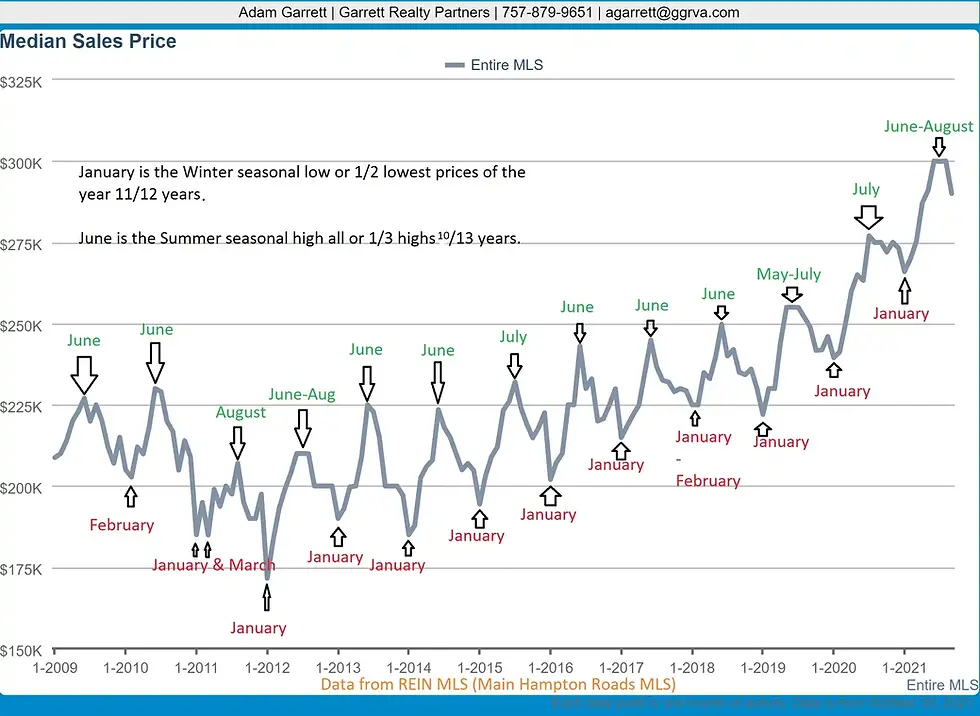
I have personally not seen another agent provide sellers with this particular depth of long-term seasonal graphing in the same way.
That does not mean no one else does.
The broader lesson is:
Market knowledge should be demonstrated—not inferred from recent sales volume.
I also maintain market-trend resources for several of the major Virginia regions I serve, including Hampton Roads, Greater Richmond, the Northern Neck, and the Middle Peninsula. These resources are intended to help buyers and sellers look beyond a snapshot of today's market and examine historical pricing, sales activity, inventory, and other trends.
Seller Education Is Part of the Service Too
Not every valuable professional activity produces another closing.
Seller education may include helping someone understand:
seasonal timing,
competing inventory,
pricing tradeoffs,
market trends,
photography and preparation,
inspection concerns,
financing conditions affecting buyers,
contract choices,
marketing options,
and the likely consequences of different strategies.
A seller who understands the reasoning behind a recommendation is better equipped to make an informed decision.
That educational work takes time.
It may not increase an agent's recent sales volume.
It can still provide substantial value.
Local Knowledge, Local Capability & Local Investment Are Different
Physical proximity can matter.
But proximity is not the same thing as knowledge or effort.
I find it useful to separate three questions.
Local knowledge
Does the agent actually understand the area?
Local capability
Does the agent have the necessary:
MLS access,
contracts,
showing systems,
lockbox access,
backup arrangements,
and infrastructure?
Local investment
How much time, research, money, and effort is the agent actually willing to invest?
A more distant agent might:
make repeated trips,
research the area extensively,
capture neighborhood & nearby amenity photography,
create aerial imagery,
document amenities,
build neighborhood resources,
or create an integrated 3D neighborhood experience.
The agent closest to the property may not be the agent willing to do the most for the property.
Adam's Area Photos For Listings (all my listings include some [unless very rural areas, i.e., some parts of the Northern Neck that are away from town & don't have any substantial nearby area amenities where it could be a detractor], including area aerials off-site with max distance from the house and minimum number of photos dependent on listing tier & publicly disclosed)
MLS Coverage Can Matter to Buyers and Sellers—and Be Almost Invisible to Both
MLS coverage is one of the more important real-estate issues that many consumers have little reason to understand before they need an agent.
That can create problems for both sellers and buyers.
A home may appear on Zillow, Realtor.com, Homes.com, or another consumer website, making it look as though the property has complete market exposure.
But appearing on public websites is not necessarily the same thing as being entered directly into the MLS systems that local agents are actually using with their clients.
And because MLS boundaries overlap substantially in parts of Central and Eastern Virginia, simply saying:
“It's in the MLS”
does not necessarily tell you very much.
What I Mean by the “Primary MLS”
When I refer to the primary MLS for a city or county, I am not referring to an official designation assigned by the locality or an association.
I mean the MLS that had the largest share of listings in that city or county according to my most recent listing-count research.
I have researched the distribution of listings among multiple Virginia MLS systems using large samples and publish the resulting percentages so consumers can see which MLS systems appear to matter most in different localities.
Which MLS Do You Need to List or Buy Real Estate in Virginia?
Those percentages also show why this issue cannot always be reduced to one MLS.
In some localities, one system dominates.
In others, no single MLS accounts for nearly all of the listings, making access to multiple systems much more important.
Sellers May Have No Idea Their Listing Is Missing From an Important MLS
A seller generally does not spend their time studying:
MLS membership
MLS market share
Syndication agreements
Overlapping MLS boundaries
Which MLS buyer agents in their county use most often
So a seller may see their property on major consumer websites and reasonably assume that their agent has provided all of the important exposure available.
That assumption can be wrong.
During my November 4, 2026 review of high-volume agents and their listings, I found at least one high-volume agent listing resale properties in a county without entering those listings into the MLS that had the largest share of listings in that county according to my most recent research.
I am intentionally not identifying the agent.
My purpose is not to criticize an individual agent. It is to illustrate a problem that can be almost invisible to the seller.
The property can still appear online.
The listing agent can still be highly successful.
The home can still sell.
But none of those facts tells the seller whether the property received the strongest reasonable MLS exposure available in that market.
Buyers Can Be Just as Unaware
The same issue works in the opposite direction for buyers.
A buyer may hire an experienced, successful agent and assume that the property feed the agent creates represents essentially everything available in the buyer's target area.
But if that agent has access to only one MLS and a meaningful percentage of the area's listings are entered exclusively into another system, the buyer's normal MLS feed may be incomplete.
The buyer may never realize what is missing.
Public websites can sometimes help fill part of that gap, but they are not equivalent to direct MLS access.
Direct MLS access can provide advantages involving:
Automated buyer searches
More detailed search criteria
Property-status information
Prior listings
Comparable sales
Historical information
Agent-only information
More complete research into properties the buyer finds independently
This is one reason I think buyers should pay attention not only to whether an agent has MLS access, but which MLS systems the agent can actually access in the areas where the buyer wants to purchase.
The Most Important MLS May Change as You Cross a City or County Line
Central and Eastern Virginia is especially complicated because there is no single MLS that dominates every market I serve.
The most important system can change as you move among:
Hampton Roads
Williamsburg and James City County
The Middle Peninsula
Greater Richmond
The Northern Neck
Other nearby areas
Some localities are dominated by one MLS.
Others have much more fragmented coverage.
That means an agent who has excellent MLS coverage in one city may have materially weaker coverage just one or two counties away.
A large recent sales total does not tell you whether the agent has the right MLS access for your particular location.
What Sellers Should Ask
Instead of asking only:
“Will my property be listed in the MLS?”
I would ask:
“Which MLS systems will you actually enter my property into?”
Then ask:
“Based on recent listing counts, approximately what percentage of the listings in my city or county are represented by those MLS systems?”
Many agents may not know the percentage.
That is one reason I have researched and published the data.
If an agent is using only one MLS in an area where that system represents a relatively small portion of local listings, I would want to understand why.
What Buyers Should Ask
Buyers should ask a similar question:
“Which MLS systems can you directly search in the areas where I want to buy?”
If the search crosses several localities, ask whether the relevant MLS changes from one locality to another.
You may also want to ask:
“If I find a property listed in an MLS you do not subscribe to, how will you research it?”
An agent does not necessarily need access to every MLS in Virginia.
They do need appropriate access—or an effective alternative—for the markets in which they are representing you.
My Own MLS Coverage
I currently have direct access to four MLS systems and indirect access to two additional systems within Virginia.
That gives me access to up to six MLS systems depending on the transaction.
For sellers, I go farther than simply saying that I belong to several MLS systems.
My seller packages publicly describe the MLS coverage included at different price and compensation levels, including minimum coverage percentages in areas where one or two MLS systems alone would not provide sufficient coverage.
If I cannot provide the appropriate level of MLS coverage for a property, I disclose that before sending the listing agreement.
For buyers, broader MLS access can help when searches cross different market areas or when properties are not consistently entered into the same system.
MLS Coverage Is Another Thing Recent Sales Volume Does Not Tell You
A very high-volume agent may have excellent MLS coverage.
A lower-volume agent may have poor MLS coverage.
The reverse can also be true.
During my November 4, 2026 research, I found a high-volume example where the agent was listing resale properties without using the MLS that my research showed had the largest share of listings in that county.
That is exactly why annual sales volume cannot answer this question for you.
MLS coverage has to be investigated separately.
And because both sellers and buyers may have no obvious way to know what they are missing, it is one of the areas where asking the right question before choosing an agent can make a meaningful difference.
Why Sales Volume Can Differ—and What Never Appears in the Sales Count
Why Might One Agent Have Much Higher Recent Sales Volume?
Recent sales volume is partly about serving clients.
It is also partly about acquiring clients.
Agents can generate business through:
repeat customers,
referrals,
advertising,
SEO,
purchased leads,
prospecting,
networking,
persistent follow-up,
social media,
brokerage leads,
relocation programs,
and brand recognition.
Some of those may result directly from excellent previous service.
Some primarily demonstrate an ability to generate and convert leads.
Those skills are related.
They are not identical.
Referral fees can affect production too
Some agents participate heavily in referral networks or relocation programs.
An agent may be willing to accept a client while paying a significant percentage of the compensation earned on that side to the referring source. I've seen as high as 50%.
Another agent may decline the same opportunity.
That can affect which agent gets the transaction and therefore which agent records another sale.
Neither decision automatically tells you who would provide better representation.
Follow-up can affect sales volume
Persistent follow-up can win additional clients.
Responsiveness after someone asks for help is valuable.
Repeated prospect follow-up designed to convert a lead into a client is a different activity.
An agent who spends substantially more time prospecting and following up may generate more transactions without that necessarily telling you how much time the agent devotes to:
research,
seller education,
property preparation,
or individualized service after being hired.
Ethics, Judgment & Transactions That Never Become Sales
Real estate agents are generally compensated when transactions close.
That creates a simple reason why production statistics cannot capture every example of good representation.
Sometimes good advice is:
walk away,
wait,
keep the contingency,
reject the offer,
do not make the offer,
obtain another inspection,
ask another specialist,
or reconsider the transaction.
If that advice prevents a closing:
the agent receives no additional sale.
That does not mean lower-volume agents are more ethical.
It does not mean high-volume agents are less ethical.
My father is a useful counterexample.
Despite extraordinary career and recent sales volume, he has been willing to tell people not to buy or sell when he believes proceeding is not in their best interest.
In my experience, there are some illustrative examples:
I've created an article and related articles on Holistic Options to Avoid House Foreclosure, while many agents haven't created anything nearly as comprehensive that covers multiple avenues other than selling.
My rent or buy page isn't nearly as biased to buy as many other buyer agents' pages. I present a number of cases where renting can actually make sense.
I also often advise my buyer clients to rent before purchasing in a new location where they have never lived.
I've created a page on how, in many cases, adding onto your existing house that you own can be very beneficial if all you need is more space.
Production cannot measure every example of good judgment.
What Has the Agent Built From Their Experience?
This is one of my favorite questions.
What has the agent built from what they have learned?
Two agents might each have 500 career transactions.
One may have converted those experiences into:
buyer tools,
seller tools,
checklists,
offer-analysis spreadsheets,
property-comparison systems,
market trackers,
inspection resources,
financing resources,
neighborhood guides,
and research databases.
The other may have completed 500 transactions without building anything comparable.
Both have 500 transactions.
They have not necessarily extracted the same reusable value from those experiences.
Examples From My Own Work
Public, Client-Only & Private Resources
Not every useful resource is necessarily public.
Resources may be:
Public — available to anyone.
Client-only — consumers may know the resource exists, but complete access is provided to represented clients.
Private or unpublished — working documents, research, spreadsheets, checklists, or databases not publicly indexed.
So another worthwhile question is:
“What resources do you use with clients that I cannot see simply by Googling your name?”
Did the Agent Actually Create the Content on Their Website?
Do not automatically assume every article on an agent's website was personally researched or written by that agent.
Real estate websites frequently contain:
syndicated articles,
brokerage material,
vendor content,
automatically generated pages,
ghostwritten content,
or AI-assisted material.
There is nothing inherently wrong with using outside material or AI tools.
But if you are treating educational content as evidence of an agent's own knowledge, it is reasonable to determine who actually created, researched, reviewed, corrected, and substantively developed it.
There is a meaningful difference between:
content merely hosted by an agent
and
content created or substantively developed by an agent.
How AI Fits Into My Own Website
I use AI myself, and I think transparency matters here.
As of the publication of this article, my website contains more than 450 articles and pages. Fewer than 50 of those involved substantial AI work.
Even among the pages where AI has played a substantial role, that generally does not mean I entered a short prompt and published whatever came back.
The typical development process can involve:
determining the questions that need to be answered,
supplying my own professional experience and examples,
directing additional research,
comparing sources,
correcting AI errors or overly broad conclusions,
challenging claims that do not appear adequately supported,
reorganizing material,
adding or removing sections,
integrating my own resources,
checking links and sources,
refining wording,
creating or reviewing graphics,
and making the final editorial decisions.
Among the pages where AI has been used substantially, the median & average amount of time I spend developing a page is still measured in hours rather than minutes.
That distinction matters to me.
AI can make research, organization, comparison, and drafting dramatically more efficient. It does not mean that I simply outsource the thinking behind the resource.
The substantive value of a page should still be judged by things such as:
the quality of the research,
the usefulness of the information,
the evidence supporting important claims,
the professional experience incorporated into it,
the amount of human review and correction,
and whether the person publishing it is willing to take responsibility for the final content.
So when evaluating an agent's educational resources, I would not ask only:
“Was AI used?”
A more useful question is:
“What role did the agent actually play in researching, developing, reviewing, and taking responsibility for this material?”
Technology Doesn't Prove Quality—But It Can Change What an Agent Can Offer
Technology is not valuable merely because it is new.
It is valuable when it improves:
research,
communication,
marketing,
documentation,
visualization,
efficiency,
seller education,
or client understanding.
Examples from my own practice include:
Matterport,
aerial media,
screen-sharing consultations,
AI-assisted research and workflows,
market-analysis resources,
digital comparison tools,
and other technology.
My e-PRO certification is one small indication of continuing technological engagement.
The stronger evidence is what I actually use.
My Own Production Shows Why Recent Sales Volume Needs Context
My own career provides a concrete example.
I reached my highest annual production in 2020 with 29 sales totaling more than $8 million.
My annual sales later declined.
During much of that same period of declining sales, however, I substantially increased the time I invested in research, educational resources, market analysis, technology, media, and other tools I can provide clients.

My Own Numbers — What Changed After My Highest-Production Years?
I have personally handled more than 140 real estate transactions during my career.
My highest-production year was 2020, when I closed 29 sales totaling more than $8 million.
My annual transaction count later declined. But I did not simply replace real estate with something unrelated. I increasingly redirected professional time toward research, educational resources, market analysis, technology, media, and tools designed to improve what I can offer buyers and sellers.
Certain major spreadsheets and resources began especially heavy development in 2022. My comprehensive buyer and seller guides followed in 2023. In 2024, I created my area guide, produced my first two 3D neighborhood experiences for listings, and produced my first premium seller video.
2025 and 2026 may have been the most research-productive years of my career. In 2026, I also developed the widget used on my regional housing-market pages and client-focused flood-map resources.
More than 80% of the articles and pages currently on my website were published from 2022 through the publication of this article.
That does not mean lower transaction volume automatically produces better service. It does mean that transaction count alone cannot tell you whether an agent's capabilities, resources, knowledge base, or service offering have expanded or contracted.
The 2020 version of me closed more transactions.
The current version of me can offer buyers and sellers substantially more.

8 Recent Sales vs. 124 — My Father's High-Volume Counterexample
A useful counterexample exists within my own family.
My father, Greg Garrett, has sold more than 4,000 properties during his career and remains a very high-volume agent. As of October 30, 2026, REIN records showed 124 transaction sides for him during the preceding 365 days—and that does not include transactions outside REIN.
By comparison, I had 8 closings during my preceding 365 days.
I want to be very clear about what that comparison does not mean: my father is an excellent real estate agent. High production and excellent representation can absolutely coexist.
But even a great high-volume agent may not be the best fit for every individual client.
Years ago, my father and I were eating at a rooftop restaurant in Norfolk. He pointed toward a nearby couple and essentially asked me: if they wanted to buy a home, which one of us would do the better job for them?
I told him I thought I would.
He agreed.
I do not interpret that conversation as him saying I was a better real estate agent overall. I interpret it as something much more important to this article: the agent with the greater transaction count is not automatically the better fit for every particular client.
Different agents can bring different strengths.
One may have extraordinary transaction repetition, negotiation experience, industry relationships, and pattern recognition.
Another may currently have more time available per client, perform more individualized research, build more detailed educational resources, use different technology, or have a service model that better matches what a particular buyer or seller values.
That is why I would not tell a consumer simply to choose the agent with 124 recent transaction sides over the agent with 8—or the reverse.
I would tell them to investigate what each person actually offers.
His 4,000+ Sales Are Not My Sales—but His Experience Is Still a Resource
Consumers should also distinguish between an agent's own experience and experience that exists elsewhere in the agent's organization or professional network.
My father's 4,000+ career sales are his—not mine.
I would never represent those transactions as my personal production.
At the same time, it would be equally misleading to pretend that growing up in a real estate family, learning from him, working in the same brokerage, and continuing to have access to his experience provide me with no benefit.
My father has taught me a great deal about real estate and remains someone I can ask questions when an unusual situation arises.
That distinction matters when evaluating teams and brokerages generally.
An agent may have access to exceptional mentors, brokers, attorneys, transaction coordinators, specialists, or experienced team members. Those resources can add real value.
But organizational experience and personal experience should still be identified honestly.
The useful questions are:
How much experience has this particular agent personally accumulated?
and
What additional expertise can the agent actually access when a transaction requires it?

Want My Service Model Plus 4,000+ Personal Sales of Experience? Co-Listing Is an Option
For some sellers, this does not have to be an either-or choice.
A seller who likes my research, resources, technology, media capabilities, and service model but also wants the direct involvement of an agent with more than 4,000 personal career sales can ask about co-listing with my father.
That can provide a hybrid approach rather than forcing a seller to choose entirely between two different sets of strengths.
In one recent co-listing, for example, I added area-marketing resources that my father—and, to my knowledge, other agents marketing that particular property—had not developed to the same degree.
Those resources included an interactive 3D experience incorporating both the home and surrounding neighborhood, along with unusually extensive aerial imagery of the area.
That does not make every property a good candidate for co-listing, and it does not mean my father must be involved in every transaction I handle.
It simply illustrates a larger point:
Agent selection does not always have to be framed as choosing one person's strengths while completely giving up another person's strengths.
Explore an example of a 3D home and neighborhood experience from a recent co-listing
What Might You Give Up by Choosing a Higher-Volume Agent Instead of Me?
Another Central or Eastern Virginia agent may have substantially more sales during the past year than I do.
Once I have established that an agent is still active, I personally put relatively little weight on that number when I am looking for an agent to whom I can refer a buyer or seller. I care much more about the agent's total career experience, competence, ethics, relevant knowledge, actual work quality, resources, tools, and what they will actually provide the client.
I think consumers should make a similarly broad comparison.
If another agent has substantially higher recent production, don't ask only what you might gain from choosing that agent.
Also ask: What might you give up?
Research basis: On November 4, 2026, I used Homes.com five-year sales-volume data to identify the highest-volume resale-focused agent or broker across 10 cities and counties in Hampton Roads, Greater Richmond, the Northern Neck, and the Middle Peninsula. After excluding essentially new-construction-only agents, those localities represented 9 unique agents or brokers. Their publicly available services, resources, websites, and other information were then researched for the comparisons below.
Also ask:
What might you give up?
If You're a Seller: What Might You Give Up by Choosing a Higher-Volume Agent Instead of Me?
For sellers, much of an agent's actual work can be investigated before you ever meet them.
What I Found When I Checked High-Volume Agents' Listings
On November 4, 2026, I reviewed $150,000+ resale listings from some of the highest-volume agents and brokers I identified across Hampton Roads, Greater Richmond, the Northern Neck, and the Middle Peninsula.
Ten local-market selections represented 9 unique agents/brokers.
Across the qualifying listings I reviewed:
0 of 9 consistently displayed off-site area or amenity photography.
0 of 9 consistently displayed aerial photography.
Only 1 of 9 consistently displayed a 3D tour.
0 of 9 consistently displayed all three.
I even found more than one qualifying listing from an agent whose website stated that every listing receives aerial/drone photography where aerial photographs were not visible.
There may be explanations I cannot determine from the public record, so I am not accusing that agent of breaking a promise.
The lesson is simpler:
Compare what an agent says they provide with multiple examples of what actually appears in their listings.
Some of My Marketing Capabilities Are Unusually Extensive
Depending on the property and package, my listing services can include:
Professional photography
Aerial photography/video
Zillow 3D
Matterport Pro3
Exterior Matterport coverage
Aerial 360s
Premium video
Off-site area and amenity photography
Off-site aerial imagery
3D neighborhood experiences
Floor plans and virtual staging
I did not find another agent in this comparison group publicly offering the same type of integrated 3D neighborhood experience I can provide for qualifying listings.
I also did not find another one publicly advertising Zillow 3D and Matterport together as a standard package combination, or routine residential Matterport coverage around the full exterior comparable to my 3% package.
I Publish Much More Detail About What Sellers Actually Receive
My public seller page describes:
2.5%, 2.75%, and 3% listing-side packages
What changes between the tiers
Property-price and geographic thresholds
MLS-coverage standards
Media and 3D differences
Separately priced à-la-carte marketing options
As of my November 4, 2026 review, I did not find another one of the nine high-volume agents/brokers publicly offering the same combination of three defined seller tiers + detailed inclusions/limitations + separately priced marketing add-ons.
Some competing agents were much more transparent than others, so this is not a claim that nobody else explains their services well.
It is a comparison of degree.
MLS Coverage, Research, and Seller Resources Can Matter Just as Much
I have direct access to four MLS systems and indirect access to two additional systems in Virginia.
During the same November 4 review, I found at least one high-volume agent listing resale properties in a county without using the MLS that had the largest share of listings in that county according to my most recent listing-count research.
Most sellers would have little reason to know that.
My seller offering also includes:
A seller guide incorporating 100+ articles/pages I created
Competing-offer comparison tools
Responsibilities and obligations resources
Market research
Area information
Flood and environmental resources
Property-specific research
I did not find another individual agent in this comparison group with a publicly visible seller-education library approaching the breadth of mine.
That does not mean another high-volume agent cannot equal or exceed me in some of these areas.
If they do, give them credit for it.
But determine that from the actual work and actual offering, not from the number of homes they sold last year. Compare My Full Central & Eastern Virginia Seller Offering
Research note: I reviewed publicly available agent/brokerage websites and selected listing histories on November 4, 2026. Offerings and websites can change, and agents may privately provide services that were not publicly visible when I checked.
If You're a Buyer: What Might You Give Up by Choosing a Higher-Volume Agent Instead of Me?
A higher-volume agent may have substantially more career experience than I do. That deserves consideration.
But once an agent is sufficiently experienced and clearly active, I would also compare what that person can actually do for you.
For the much more complete version of my buyer offering:
What Adam Offers Central & Eastern Virginia Buyers
Research, Education, and Decision Support
A substantial part of my buyer service happens before and between showings.
My resources include:
A buyer guide incorporating 100+ articles I created
Offer-analysis tools
Responsibilities and obligations resources
Property and prior-listing research
Market and area research
Flood and environmental resources
Extensive credit and financial resources
Among the high-volume agents I reviewed on November 4, 2026, I found some good buyer guides, mortgage resources, and community information. I did not find another individual agent with a publicly visible buyer-education and credit/financial resource system comparable in overall breadth to mine.
I also research property-specific issues rather than assuming everything important will appear in the MLS remarks.
Adam's Credit & Financial Resources
Physical Tools and Buyer-Specific Technology
This is something I personally consider when evaluating an agent as a potential buyer referral source.
Depending on the property, my showing tools can include:
Powerful lighting
Thermal imaging
Borescopes
Moisture meter
Outlet tester
Laser measurement
Ladders or camera poles
Stabilized virtual-showing equipment
Tablet
Drone
Owning gadgets does not make someone a good agent. But useful equipment can expand what a capable agent can see, document, or communicate.
I did not find another agent in the comparison group publicly describing a comparable buyer-showing toolkit.
I can also use my drone for buyers when appropriate—for example with acreage, roofs, waterfront surroundings, or neighborhood context.
For certain qualifying out-of-town buyers who have a property under contract but have never physically seen it, I can also provide a Matterport Pro3 tour with the seller's permission.
Those are buyer-specific capabilities I did not find publicly offered by the other high-volume agents I reviewed.
MLS Access and Direct Service
I have direct access to four MLS systems and indirect access to two additional systems in Virginia.
That can matter because the most important MLS can change as a buyer moves between different parts of Central and Eastern Virginia.
Broader access can help with:
Searches
Prior listings
Comparable sales
Property histories
Research into homes you find independently
I also think buyers should determine who will actually be representing them.
A high-volume team leader may have extraordinary experience while much of the buyer's work is handled by other agents or showing assistants.
If you hire me, you are hiring me. When I occasionally need help with a time-sensitive showing, I prefer experienced agents within my brokerage rather than simply whoever happens to be available.
More Up-Front Detail About What You Actually Receive
My public What I Offer Buyers page explains in substantial detail things such as:
Research and educational resources
Showing tools
MLS access
Virtual-showing capabilities
Buyer Matterport and drone capabilities
Backup-showing arrangements
Representation options
Fees
Direct involvement
As of my November 4, 2026 review, I did not find another individual agent in the high-volume comparison group publicly explaining their buyer offering at a comparable level of detail.
That does not mean another agent cannot provide excellent service—or even provide capabilities I do not.
The point is simply that higher recent sales volume does not establish that the buyer will receive everything I provide.
Compare the actual service, resources, tools, research, judgment, and representation—not just the closing count.
Compare My Full Central & Eastern Virginia Buyer Offering
Research note: I reviewed publicly available agent and brokerage websites on November 4, 2026. Offerings can change, and an agent may provide services privately that were not publicly disclosed when I checked.
How to Evaluate an Agent Beyond Their Sales Numbers
How AI Can Help You Investigate a Real Estate Agent
Artificial intelligence can make it much easier for consumers to compare agents—but it should be used as an investigative tool, not treated as an unquestionable authority.
For example, you can give an AI tool links, screenshots, exported sales histories, marketing examples, or information from several agents and ask it to:
Compare the actual services each agent offers.
Identify meaningful differences between their websites.
Compare several recent listings from each agent.
Look for differences in photography, descriptions, video, 3D media, aerial imagery, floor plans, and area marketing.
Separate an agent's personal sales history from team or brokerage production.
Organize sales records into a spreadsheet.
Identify possible duplicates or inconsistencies.
Compare years in the business with actual transaction history.
Identify questions you should ask each agent.
Flag claims that appear to need verification.
Compare educational resources and market research produced by the agents.
AI can dramatically reduce the amount of work required to perform this kind of comparison.
But AI can also misunderstand records, confuse similarly named agents, misread dates, accept inaccurate website claims, or make incorrect assumptions about what a particular number represents.
For important decisions, use AI to help you find questions and organize evidence—not to replace verification.
What to Research Before Choosing a Listing Agent
A substantial amount of agent selection can be done before you ever agree to a listing appointment.
That matters because research lets you look at evidence rather than relying only on how well an agent sells themselves during an interview.
1. Start With Total Career Experience; Use Recent Sales Primarily to Confirm They Are Still Active
If you are trying to determine how experienced an agent is, I would put substantially more weight on the total number of transactions they have personally handled over their career than on how many they closed during the past 12 months.
Career transaction volume is the better measure of actual transaction experience.
An agent who has personally handled hundreds or thousands of transactions has had repeated opportunities to encounter different:
Markets
Contracts
Negotiations
Inspections
Appraisals
Financing problems
Property issues
Personalities
Unusual circumstances
Transactions that nearly failed or actually failed
Years of substantial or full-time real estate work add additional context.
Recent sales answer a different question primarily:
Is this agent still active in real estate?
If someone has substantial career experience but has not completed a transaction in several years, that deserves further investigation.
But once you establish that an experienced agent is still active, I would not assume that someone with 30 sales in the past year is three times as experienced—or necessarily better—than someone with 10.
For example:
500 career transactions and 8 during the past year
60 career transactions and 20 during the past year
The second agent has more recent sales.
The first has substantially more transaction experience.
Those are not equivalent measures.
Depending on your property and market, it can be reasonable to establish a minimum career-experience threshold—perhaps 50 or 100 personally handled transactions—while still considering agents far above that threshold based on factors other than who sold the most homes last year.
Also make sure the number represents the individual agent's personal production, rather than team or brokerage production.
Practice makes permanent—not necessarily perfect. Total experience matters greatly, but experience should still be evaluated alongside the quality of the agent's work.
2. Research Their Reviews—and the Values Those Reviews Demonstrate
Do not simply compare review counts.
Agents differ significantly in how aggressively they seek reviews.
Instead, actually read them and look for repeated evidence of qualities such as:
Staying available
Working hard
Saving clients money
Keeping clients' interests first
Educating clients
Integrity and high ethical standards
Excellence
A large number of reviews is useful evidence, but the substance of those reviews can tell you much more.
3. Research What They Actually Offer Sellers
Look for hard evidence rather than broad claims such as “full service” or “premium marketing.”
Depending on the property, look for things such as:
Professional photography
Aerial photography or video
Matterport or another 3D tour
Premium video
Area and amenity photography
Strong public and agent remarks
Floor plans
Virtual staging options
Physical or functional staging options
Seller education
Market research
MLS coverage
Other property-specific services
An agent's recent sales count tells you how many transactions they completed.
It does not tell you what they actually provided those sellers.
4. Inspect Their Actual Previous Listings
This is one of the strongest forms of research available to a seller.
Do not rely only on a few hand-picked showcase listings.
Look at several actual recent listings and, when possible, include:
Lower-priced properties
Fixer-uppers
Properties that are not naturally photogenic
Listings where good marketing required more effort
Examine:
Quality and quantity of photography
Aerial media
3D tours
Video
Floor plans
Area and amenity photos
Public remarks
Agent remarks
Photo captions
Property details
Searchable MLS fields
Whether important property characteristics appear to have been entered
How thoroughly the surrounding area is marketed
A listing can look attractive to a casual viewer while still omitting searchable MLS information that causes it to miss buyers whose searches include those features.
5. Look for Patterns Across Their Listings
Do not merely ask whether an agent offers something.
See whether they actually provide it consistently.
For example:
Do only the highest-priced listings receive aerials?
Are 3D tours common or rare?
Does photography quality decline sharply on less-expensive properties?
Do some listings contain extensive information while others contain very little?
Does the agent regularly market neighborhoods and amenities?
Are strong remarks typical?
There may be valid reasons for differences.
Finding those patterns gives you much better questions to ask during the listing appointment.
6. Compare Different Agents' Listings of the Same Property When Possible
A particularly useful comparison is a property that has been listed by different agents at different times.
Because the underlying property is largely the same, you can more easily compare differences in:
Photography
Remarks
Searchable fields
Property details
Aerial media
3D media
Area marketing
Overall presentation
This can sometimes reveal more about the agents than comparing completely different properties.
7. Research Their Geographic Coverage, Property-Type Experience, and Price Range
These factors matter, but they are often interpreted incorrectly.
For price range, the most important initial question is usually:
Will this agent actually serve me at my price point?
If you are selling a $75,000 property and the agent has not handled anything below $500,000 in years, reaching out may not make sense.
But the reverse is different.
If an agent has excellent marketing, strong education, substantial transaction experience, and a service model well suited to your property, the fact that they have not previously sold something as expensive as yours should not automatically disqualify them.
Higher price-point experience is not itself proof of higher-quality representation.
Also investigate relevant property-type experience, particularly for things such as:
Land
Commercial property
Condominiums
Co-ops
Other unusual properties
If the individual agent lacks relevant experience, determine whether someone with that experience would be substantially involved.
8. Research Their MLS Access and Coverage
In areas where multiple MLS systems matter, this can be extremely important.
Determine:
Which MLSs the agent can access
Which MLSs are important in your city or county
Whether their previous listings suggest they actually use multiple MLSs where appropriate
Access and use are not the same thing.
An agent can belong to four MLSs but put your home into only one.
The exact MLSs that would be used for your property is something to confirm during the interview.
9. Research What They Have Published or Created
Look at:
Articles
Guides
Videos
Market research
Area resources
Spreadsheets
Calculators
Educational material
Other tools
A large body of substantive material across many real-estate subjects can provide evidence of ongoing research and professional development that sales counts do not capture.
But determine whether the agent was actually substantively involved.
A large volume of syndicated, purchased, brokerage-provided, outsourced, or automated content should not receive the same weight as work the agent actually researched, developed, reviewed, and uses with clients.
10. Research Education, Professional Development, and Related Experience
Consider:
Years of substantial/full-time real-estate experience
Formal real-estate education
Informal professional education and research
Certifications and designations
Broker education
Related professional backgrounds
Not all credentials are remotely equal.
Some require significant education and transaction experience. Others require very little.
Related experience in areas such as appraisal, construction, home inspection, lending, engineering, insurance, marketing, photography, or other fields can also add relevant capabilities.
11. Determine Whether You Are Hiring an Individual or a Team
If a team advertises hundreds of transactions, determine whose transactions those actually were.
Research:
Who would personally represent you
Whether the lead agent regularly passes clients to other agents
The experience of those agents
What reviews say about the team's structure
A highly experienced team leader can be a major resource.
But being on that person's team is not necessarily the same thing as being personally represented by them.
12. Look at the Depth of What They Communicate
Look at their:
Website
Articles
Videos
Guides
Emails
Social-media material
Initial correspondence
Are they mostly telling you about their production and awards?
Or are they also giving you useful information, explaining real-estate issues, identifying nuances, and helping consumers make better decisions?
How well an agent markets themselves and how well they educate and represent you are not identical skills.
For substantially more detail:
What to Ask—and Observe—When Interviewing a Listing Agent
Your research should narrow the field.
The listing appointment then gives you an opportunity to evaluate things that cannot be determined accurately online and to ask about anything your research uncovered.
1. Pay Attention to the Property Walk-Through
Does the agent actually inspect your home carefully?
Do they notice things involving:
Repairs
Cleaning
Presentation
Staging
Photography
Property features
Buyer perception
Marketability
A good listing appointment should provide you with useful information about your property—not merely give the agent an opportunity to make a sales presentation.
2. Are They Candid and Honest?
Pay attention to whether the agent is willing to tell you things you may not want to hear.
That could involve:
Repairs
Cleaning
Preparation
Weak property features
Pricing
Competition
Market conditions
An agent who tells you everything is perfect and gives you the highest suggested price may be pleasant to interview.
That does not mean they are giving you the best advice.
You should be looking for an advocate, teacher, and expert, not merely the person who is best at befriending you during a listing appointment.
3. Ask to See the Comparable Sales
The agent should be able to show you the comparable sales supporting their pricing recommendation and explain the reasoning.
Ask:
Which sales are most comparable?
Why?
What differences matter?
What competing listings matter?
How did the agent arrive at the suggested range?
The highest suggested list price is not automatically the best advice.
4. Ask What Marketing Would Typically Be Included for Your Property
Do not ask only:
“Can you do this?”
Ask:
“Is this something you would typically do for my property under the listing package we're discussing?”
Depending on your property, ask about:
Professional photography
Aerials
Matterport/3D
Premium video
Floor plans
Area photography
Staging
Open houses
Social media
Marketing to other agents
Signage
Buyer-facing advertising
Other property-specific services
There is a major difference between something an agent has done once and something that is part of their normal offering.
5. Ask About Differences You Found in Their Previous Listings
For example:
“I noticed some of your listings had 3D tours and aerial photography while others didn't. What determines that, and what would apply to mine?”
Or:
“I noticed your marketing appeared substantially different at different price points. What would I receive?”
Research first.
Then use the interview to explain what the evidence showed you.
6. Ask Which MLSs Your Property Would Actually Be Entered Into
Do not stop at:
“Which MLSs do you belong to?”
Ask:
“Which MLSs would you actually put my listing into?”
That is what matters.
7. Ask About Staging and the Buyer's Experience in the Property
Depending on your needs, ask about:
Staging recommendations
Physical or functional staging options
Listing flyers
Materials left in the property
Other ways the agent improves the buyer's experience during a showing
These details are rarely reflected in an agent's transaction count.
8. Ask About Their Physical and Digital Tools
Technology and equipment are not substitutes for experience.
But they can enhance what an experienced agent is capable of doing.
Ask what tools the agent uses for:
Photography/video
Virtual showings
Property research
Showing management
Marketing
Communication
Other relevant tasks
9. Ask How Showing Requests Are Handled
The system used to schedule and communicate about showings can affect how easy your property is for buyer agents to show.
Ask:
How are showing requests received?
How quickly are they handled?
What information do showing agents receive?
How is feedback handled?
10. Ask About Dual Agency
Ask:
Does the agent engage in dual agency?
Under what circumstances?
How often?
What alternatives would be available?
This is worth understanding before a buyer represented by your own agent becomes interested in the property.
11. Ask What They Believe the Selling Features of Your Property and Area Are
A listing agent should not need you to identify every positive feature.
Ask what they believe should be emphasized about:
The property
The neighborhood
Nearby amenities
The broader location
Then compare that answer with what you saw in their previous listings.
12. Ask How They Handle Multiple Offers—and How They Evaluate Buyers
If you receive competing offers:
How will they help you compare them?
Do they have a structured method?
What factors besides price will they evaluate?
How will they investigate the strength of the buyer and financing?
How will they communicate with the competing agents?
A raw sales number tells you nothing about the quality of this analysis.
13. Understand What They Charge and What Changes With Different Compensation Levels
Ask about:
Listing-agent compensation
Any buyer-agent compensation being discussed
Administrative or transaction-coordinator fees
Optional additional marketing
Whether services change under different packages
An agent charging more is not necessarily better.
An agent charging less is not necessarily the better value.
Compare cost with what you actually receive.
14. Understand Your Options if the Relationship Does Not Work
Review the listing agreement and ask about:
Cancellation
Expiration
Any protection period after expiration
Whether you could be required to work with someone else within the brokerage
Other terms that would matter if circumstances change
15. Be Careful With Popular Questions That Can Mislead When Asked in Isolation
Questions such as these may sound useful:
What is your list-price-to-sales-price ratio?
How many homes have you sold in my neighborhood?
None is inherently bad.
But each can mislead without context.
An agent who routinely underprices homes may have faster sales and a spectacular list-to-sale ratio.
An agent who has sold five homes in your subdivision but barely markets the neighborhood may be a worse choice than someone with fewer neighborhood sales who has strong city/county experience, appropriate MLS coverage, and consistently excellent area marketing.
Ask questions that help you understand why the numbers look the way they do, not merely who has the most impressive number.
What to Research Before Choosing a Buyer's Agent
Much of a buyer's-agent search should also occur before you contact the agent.
Your goal is not to identify whoever has the largest recent sales count.
It is to determine whether an agent has substantial experience, remains active, serves your needs, and appears to offer unusually strong representation.
1. Start With Total Career Experience; Use Recent Sales Primarily to Confirm Current Activity
For experience, focus first on:
Total transactions personally handled
Years of substantial or full-time real-estate experience
Those are much stronger indicators of accumulated transaction experience than the number of closings during one recent year.
Recent sales are useful primarily because you want to know that the agent is still active.
An agent with hundreds of career transactions who completed 8 purchases or sales last year has not somehow become less experienced than an agent with 60 career transactions who happened to complete 20 last year.
Once you establish that an experienced agent remains active, other differences become more important than simply asking who had the most closings during the past 12 months.
Depending on your situation, you may reasonably establish a minimum career transaction threshold, such as 50 or 100 personally handled transactions.
But after reaching an adequate experience level, investigate quality, rather than simply continuing to rank agents by volume.
Also distinguish personal production from team or brokerage numbers.
2. Research Whether They Cover Your Target Area and Price Range
The price-range question is important primarily because it can tell you whether the agent is likely to work with you.
If you are trying to buy a $50,000 lot and the agent has not worked below $300,000 in years, they may not be interested.
But do not assume that an agent who has sold many higher-priced properties will automatically provide better representation.
Look at what the agent actually offers.
Also investigate:
Where the agent works
Whether they cover all of the areas you are considering
Whether coverage changes by price point
3. Research Their Buyer-Side Experience
An agent may have a large career sales total while working predominantly as a listing agent.
Look at transaction histories where available and determine how frequently they have actually represented buyers.
Total career experience remains important, but if you are hiring a buyer's agent, buyer-side experience provides useful additional context.
4. Research Property-Type Experience
This can be especially important for:
Land
Commercial real estate
Condominiums
Co-ops
Investment property
Other unusual purchases
An agent with hundreds of residential-home transactions but no land experience can still have a steep learning curve on issues unique to land.
If the agent lacks direct experience, determine whether someone with relevant experience will be substantially involved, rather than simply available in theory.
5. Read Their Reviews for Evidence of Values
Do not merely count reviews.
Look for repeated evidence of:
Availability
Hard work
Saving clients money
Keeping clients' interests first
Educating clients
Integrity and high ethical standards
Excellence
Agents differ in how aggressively they solicit reviews, so the content may be more revealing than the total count.
6. Research Ethics, Honesty, and Client-First Behavior Where Evidence Is Available
A buyer's agent is paid when a transaction closes.
That makes evidence that an agent is willing to prioritize a client's interests over simply completing the transaction particularly valuable.
Look for reviews, published material, or examples demonstrating:
Candor
Willingness to identify problems
Education about risks
Advising clients against poor decisions
Putting the client's finances ahead of the agent's short-term compensation
7. Examine What They Have Published
Look at:
Buyer guides
Articles
Videos
Market research
Financing resources
Property-condition information
Area resources
Contract education
Other tools
A large body of substantive material can provide evidence of the depth of the agent's knowledge.
Again, investigate whether the agent was actually substantively involved in creating it.
8. Research Their Education and Professional Development
Consider:
Formal real-estate education
Informal research and education
Certifications
Designations
Broker education
Contract-specific training
Do not simply count credentials.
Investigate what was actually required to earn them.
9. Consider Relevant Experience Outside Traditional Real Estate Sales
Experience in fields such as these can sometimes add substantial value:
Appraisal
Construction
Home inspection
Lending
Engineering
Insurance
Other relevant areas
Transaction count is important, but it is not the only source of useful expertise.
10. Determine Whether You Will Work With the Agent You Are Researching
With a team, determine:
Whose sales are being advertised
Who would actually represent you
Whether the team lead normally works directly with buyers
How experienced other team members are
If you choose an agent because of their 1,000 career transactions but are passed to an agent with 20, that distinction matters.
11. Research Their MLS Access
Determine which MLS systems cover the places you are considering and which ones the agent accesses.
MLS access can affect:
Automated searches
Research on properties you find elsewhere
Comparable sales
Historical property information
Also consider how much experience the agent has in the dominant MLS and with the contracts commonly used in that area.
12. Look at What They Communicate
Compare:
Website material
Emails
Articles
Videos
Guides
Initial responses
Do they demonstrate depth?
Do they educate?
Do they explain issues rather than merely advertising themselves?
13. Consider Personal or Niche Preferences That Matter to You
Some factors will matter greatly to one buyer and not at all to another.
Those could include:
Communication preferences
Particular property interests
Accessibility needs
Personal values
Faith preferences
Specialized logistical concerns
Other unusual circumstances
The point is not that everyone should use the same criteria.
It is that you should know your criteria before an agent's sales pitch establishes them for you.
For substantially more detail:
What to Ask—and Evaluate—When Interviewing a Buyer's Agent
The appointment should help you evaluate things that could not be adequately determined through research alone.
1. Evaluate Their Industry Knowledge
You do not need to give the agent a real-estate exam.
But their answers should demonstrate that they understand what they are doing.
Pay attention to whether they can explain:
The purchase process
Your target market
Contracts commonly used in the area
Financing considerations
Property issues
Offer strategy
Important risks
Good explanations matter more than jargon.
2. Ask About Their Physical Tools
Depending on your situation, useful buyer-agent equipment can include:
A strong camera phone
Stabilization for live or recorded virtual showings
Additional lighting
Powerful flashlights
Equipment for viewing difficult-to-see areas without unnecessary risk
Other property-inspection or showing tools
You may never need every tool.
But the infrastructure an agent invests in can affect the quality of service they are capable of providing.
3. Ask About Their Digital Tools and Resources
Ask what they have available for:
Property searches
Market research
Offer analysis
Comparing properties
Financing research
Area research
Client education
Other transaction tasks
The issue is not technology for technology's sake.
It is whether the technology helps the agent provide you with better information or service.
4. Ask Which MLSs They Can Search and Research Directly
Ask:
Which MLSs can you search?
Which MLSs dominate the areas I'm considering?
What happens if I find a property in another MLS?
Can you still research it effectively?
How long have you worked in the primary MLS for this area?
How familiar are you with the contract commonly used there?
This can matter much more in an area where listings are fragmented across multiple MLS systems.
5. Understand Their Buyer-Brokerage Policy Before Signing
Ask about:
Exclusive versus non-exclusive representation
Compensation
Minimum compensation requirements
Minimum purchase price, if any
Length of the agreement
Cancellation provisions
Other material terms
Do not wait until you have found a house and are under pressure to write an offer before discovering what the agent requires.
6. Ask How Showing Fill-Ins Work
Ask what happens if the agent is:
Out of town
Sick
Already booked
Otherwise unavailable when a property needs to be seen quickly
Then ask about the person who would fill in.
Consider:
Transaction experience
MLS access
Knowledge of the area
Ability to perform a high-quality virtual showing if needed
If you choose an agent partly because of their experience, being routinely handed to inexperienced fill-ins can undermine that advantage.
7. Ask Whether They Restrict Your Choice of Lender
A preferred lender can be useful.
A requirement to use one can be very different.
Lenders vary in:
Loan programs
Grants and assistance
Costs
Underwriting
Escrow-holdback policies
Other options
Understand whether you retain the ability to compare alternatives.
8. Ask About Administrative or Transaction-Coordinator Fees
Some agents or brokerages charge buyers an additional administrative or transaction-coordinator fee.
Others absorb the cost or do not use that structure.
Know the total cost before signing.
9. Ask How They Handle Dual Agency
Ask:
Does the agent practice dual agency?
How often?
Under what circumstances?
What alternatives would be available?
It is better to know the policy before you become interested in a property where the issue arises. It's legal in VA. In some states, it is not.
10. Ask How the Resources You Found Would Actually Be Used With You
If the agent has:
Buyer guides
Offer-analysis spreadsheets
Financing resources
Property-condition information
Area resources
Market tools
Other educational material
ask how those resources are actually integrated into their buyer representation.
Having resources and actually using them to educate clients are not necessarily the same thing.
11. Ask About Anything Your Research Left Unclear
For example:
“Your team advertises 600 sales. About how many have you personally handled?”
“Most of the transactions I found were listings. How much buyer representation have you personally done?”
“I don't see many purchases at my price point. Is this a purchase you would personally represent?”
“Your website lists several MLS systems. Which ones would you actually use for my search?”
Research should generate better questions.
12. Pay Attention to How They Communicate
Notice whether the agent:
Answers questions directly
Explains reasoning
Educates you
Discusses tradeoffs
Acknowledges limitations
Is willing to say they do not know
Is willing to research something rather than bluff
The goal is not merely to find someone who performs well in an interview.
It is to see whether the knowledge, values, experience, tools, and resources you researched translate into the kind of representation you actually want.
Frequently Asked Questions
Is a high-volume real estate agent usually better?
Not necessarily.
Higher recent sales volume can indicate substantial recent transaction exposure, strong demand, efficient processes, and experience managing many transactions.
Those are legitimate advantages.
But recent sales volume does not automatically reveal marketing quality, market knowledge, research depth, seller education, ethics, personal involvement, technology, workload, or whether the agent personally performed the work represented by the advertised number.
Is a low-volume real estate agent risky?
Sometimes—but low volume by itself does not tell you why the volume is low.
The agent could be new, part-time, winding down toward retirement, struggling professionally, intentionally selective, highly specialized, heavily invested in research or resource development, or simply operating with a service model designed around fewer simultaneous clients.
Low production is a symptom, not a diagnosis.
How many recent sales should a real estate agent have?
There is no single number that makes an agent qualified or unqualified.
Recent transactions matter because real estate contracts, technology, financing, market conditions, and professional practices change.
But a consumer should evaluate recent activity alongside career experience, current workload, full-time experience, market research, service quality, and continued professional development.
Does career transaction count matter?
Yes.
Handling many transactions can provide valuable pattern recognition and exposure to unusual situations, negotiations, inspection problems, financing issues, appraisal problems, difficult personalities, contract disputes, title problems, and transactions that fail.
But repetition does not guarantee that every lesson learned was correct.
Practice makes permanent—not necessarily perfect.
Does a real estate team provide better service?
A team can provide excellent service.
Delegation can free a lead agent from administrative work and allow more time for high-value analysis, strategy, and negotiation.
The key question is what is delegated and who actually performs the work that requires professional judgment.
Should I choose the agent who lives closest to the property?
Proximity can help, but it should not be confused with market knowledge or willingness to invest in the property.
One agent may live nearby but provide minimal research and marketing.
Another may travel farther while investing substantially more time in neighborhood research, photography, aerial imagery, 3D media, market analysis, and local resources.
The agent geographically closest to the property is not automatically the agent willing to do the most for the property.
Can I verify how many homes an agent has sold?
Often, yes—although public websites are imperfect.
Consumer portals, agent profiles, brokerage websites, MLS-derived records, awards histories, and other sources can provide useful clues.
But consumers should distinguish among personal production, team production, brokerage production, buyer sides, seller sides, transaction sides, and unique properties.
When a number matters to your decision, ask the agent what exactly the number represents.
Bottom Line: Don't Ignore Recent Sales Volume—Interpret It
Recent sales volume matters.
Career experience matters.
Current professional activity matters.
Current workload matters.
But none of those numbers is a complete quality score.
A high-volume agent may be an outstanding choice. A lower-volume agent may be an outstanding choice. Either one can also be a poor fit for a particular consumer.
The better question is not simply:
“Who sold more homes recently?”
It is:
“Which agent's relevant experience, marketing quality, market knowledge, research, strategy, technology, client education, ethics, judgment, current capacity, and service model best fit my specific needs?”
Sales numbers deserve consideration.
They just deserve interpretation too.
AI & Research Disclosure
I use artificial intelligence in my real estate work and in developing some of the educational material on this website, and I believe that deserves transparency.
As of the publication of this article, my website contains more than 450 articles and pages. Fewer than 50 of those involved substantial AI work.
Even among pages where AI has been used substantially, the process is not typically a matter of entering a short prompt and publishing whatever appears.
My process can include:
Determining the questions the resource should answer.
Supplying my own professional experiences and firsthand examples.
Directing research.
Comparing sources.
Identifying gaps or counterarguments.
Challenging unsupported conclusions.
Correcting AI errors or overly broad statements.
Reorganizing material.
Adding or removing sections.
Integrating resources I have previously developed.
Checking links and sources.
Refining wording.
Creating and reviewing graphics.
Making the final editorial decisions.
Among pages where AI has been used substantially, the median amount of time I spend developing a page is still measured in hours rather than minutes.
AI can make research, organization, comparison, fact-checking assistance, drafting, restructuring, and editing much more efficient.
That does not mean responsibility for the finished material has been outsourced.
The central positions I take, my professional experiences, my personal examples, information about the services I provide, corrections I make, and final editorial decisions remain mine.
AI can make mistakes. So can people.
I take responsibility for the material I publish and encourage readers to independently verify information that is especially important to their decisions.
For consumers evaluating an agent's website, I think a better question than simply “Was AI used?” is:
“What role did the agent actually play in researching, developing, reviewing, correcting, and taking responsibility for this material?”


Comments