What to Look For in Home Security Before You Buy a Home
Most buyers think about security after they move in.
That’s a mistake.
👉 The biggest advantages—and problems—are already built into the home and its surroundings.
This guide focuses on what you can evaluate before you buy, where your decisions have the most impact.
🔎 2-Minute Gist (Start Here)
Most crime is opportunistic
The goal is deterrence through visibility and difficulty of access
The most important factors are:
Area & surroundings
Visibility (home + street)
Access points (doors, windows, layout)
Elevation & foundation type
📌 If a home looks visible, active, and harder to access, it is significantly less likely to be targeted.

How This Fits Into the Full System
This article is Step 1 of a 3-part system:
Article 1 (this guide) → How to choose a home with strong built-in security
Article 2 → How to set up and improve security after you move in
Article 3 → Additional considerations for elevated or unique risk situations
Important context:
👉 Article 1 matters the most
You can’t fully fix a poor layout, bad visibility, or weak location after the fact
The right starting point makes everything else easier
👉 Article 2 = mostly easy additions
Cameras, lighting, alarms, etc.
Some are upgrades, some are just nice if already present
👉 Article 3 = higher-level and situational
Not needed for most buyers
Useful for specific circumstances or elevated concerns
📌 Start with the fundamentals—everything else builds on that.
1. Area & Surroundings (Start Here)
Before the house—look at the environment.
What to Evaluate
Crime trends (not just reputation)
General upkeep of nearby homes
Activity level (people, cars, movement)
Street lighting consistency
👉 Full breakdown of Crime When Searching for a Home to Rent/Buy
What Agents Can and Cannot Say
📌 Your agent should guide your evaluation—not replace your judgment.
Gated Communities & On-Site Security
Pros:
Controlled access
Reduced casual traffic
Limitations:
Not always actively monitored
Residents and guests still create access
Can create false confidence
📌 Helpful—but not a substitute for strong fundamentals.
Proximity to Law Enforcement
Being near:
Police stations
Fire stations
…can help with response time and presence.
Additional real-world factor:
A marked police vehicle at a neighboring home can provide short-term deterrence
However:
That can change at any time
It should not heavily influence your decision
📌 Helpful signal—not a durable advantage.
2. Property Visibility (The #1 On-Site Factor)
Security starts outside.
Look for:
Clear visibility from street and neighbors
Direct lines of sight to entry points
Limited hiding spots
Red flags:
Dense shrubs near doors/windows
Blind corners
Long, hidden walkways
📌 If someone can approach unseen, everything else matters less.
3. Doors & Entry Points
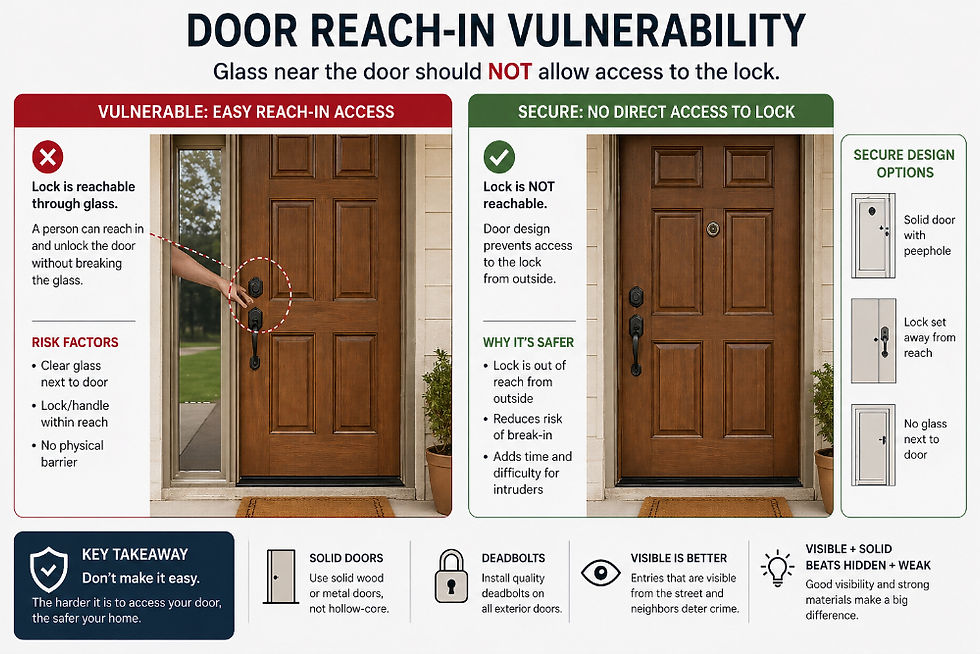
Most break-ins happen through doors.
Look for:
Solid exterior doors (not hollow)
Deadbolts & multipoint locking systems
Visible entry placement
Critical detail:
Glass near the door should NOT allow access to the lock
Simply changing a deadbolt from manual to keyed from the interior is not a good solution, as it creates a fire hazard.
📌 Visible + solid beats hidden + weak every time.
4. Windows & Access Points
Windows are often overlooked.
Window Height
Lower = easier access
Higher = more exposure
Window Size
Larger = easier entry
Smaller/divided = more restrictive
Visibility
📌 Low + hidden = highest risk📌 Higher + visible = stronger deterrence
5. Foundation Type: Slab vs Crawlspace vs Basement
This affects how easily someone can access the home.
Slab:
Ground-level access
Easier entry
Crawlspace:
Elevated
Harder to access (if secured)
Basement:
Raises main level
Adds lower-level vulnerabilities
📌 Elevation + visibility = stronger security

6. Exterior Lighting (Property + Street)
Lighting directly impacts nighttime visibility.
On-Property
Entry point lighting
Walkway/driveway visibility
Street Lighting
Consistent lighting across the street
Avoid homes in dark gaps
📌 Your lighting + street lighting = true visibility
7. Neighborhood Cameras & Shared Visibility
Especially relevant in:
Townhomes
Condos
Dense neighborhoods
Benefits:
Increased overall visibility
Shared deterrence
More potential recording coverage
Limitations:
You don’t control them
Coverage may vary
📌 Helpful layer—not something to rely on
8. Layout & Approach Paths
How someone gets to the home matters.
Look for:
Direct, visible approaches
Minimal concealed entry routes
Be cautious of:
Hidden side or rear access
Fencing that blocks visibility (not just access)
📌 Good layout reduces surprise and increases awareness.
9. Lifestyle Fit & Awareness
Security depends partly on how you live.
Think about:
Can you hear activity at night?
Nearby noise (traffic, trains, etc.)
Clear and usable exit paths
10. The Big Picture: Security Starts Before You Buy
Before adding anything, the home should already have:
Strong area fundamentals
Good visibility
Reasonable access difficulty
Lighting (home + street)
📌 Upgrades help—but they don’t fix a poor starting point.
AI Disclosure
This article was developed through an iterative collaboration between Adam Garrett and OpenAI’s GPT-5.3 business model. The core concepts, framework, and practical insights originate from Adam Garrett’s experience and perspective, with AI assisting in expanding ideas, organizing structure, and refining the presentation. Supporting resources and additional perspectives were incorporated and evaluated as part of this process, with all final content decisions made by Adam Garrett.
Final Takeaway
You don’t need a “perfectly secure” home.
👉 You need one that is:
Visible
Harder to access
Well-lit
Not isolated
That alone puts you ahead of most properties.
Next Steps
👉 Article 2: How to Set Up and Improve Your Home Security After You Move In(Focus: practical upgrades and easy improvements)
👉 Article 3: Advanced Considerations for Elevated Risk Situations(Focus: higher-level and situational planning)


Comments